
How do I fly with a dog or cat?
Which three routes exist, why the booking comes last, what breed and weather change, what the destination requires, how the costs add up and when taking the animal is the wrong decision.

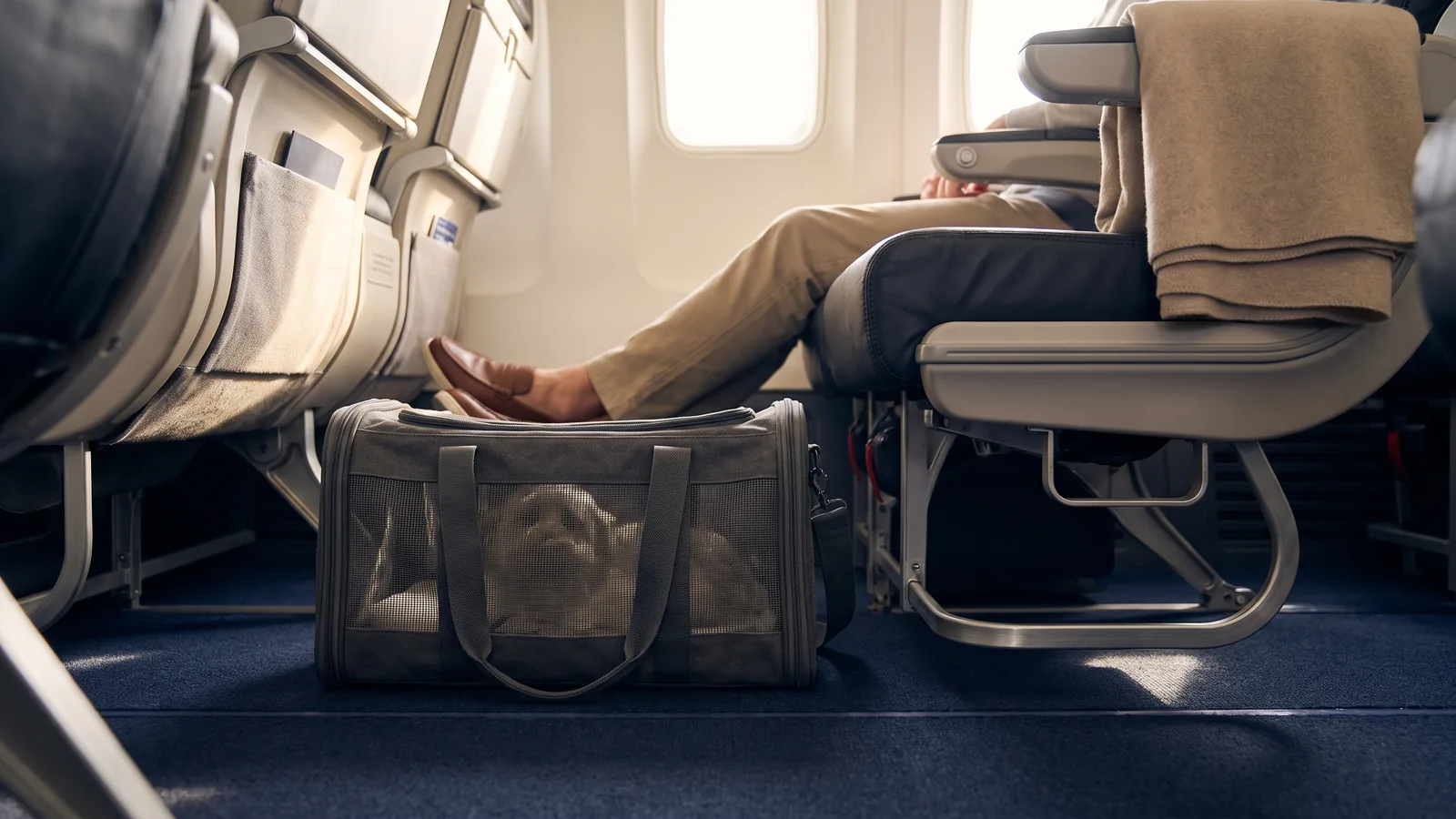 Illustrative image, AI-generated
At a glance#
| Route | typical for | booking |
|---|---|---|
| Cabin | small dogs and cats with a carrier | confirm before ticketing |
| Temperature-controlled hold | larger dogs in an approved crate | confirm before ticketing |
| Air cargo | very large animals, relocations | through a shipping agent |
| Service dog | separate rules, no fee | with documentation |
| A seat for the animal | not offered by most carriers | not applicable |
| Short-nosed breeds | frequently excluded | clarify first |
The three routes and their limits#
An animal travels by one of three routes, and the choice is not made so much as determined.
The first is the cabin. It applies to small dogs and cats whose weight together with the carrier stays below a limit each airline sets. The carrier must fit under the seat in front, be soft-sided and stay closed. The animal remains inside for the entire flight.
The second is the temperature-controlled part of the hold. It applies to larger animals in an approved hard-sided crate. The compartment is ventilated and heated, but it is not the cabin, and there is no access to the animal in flight.
The third is air cargo. That is the route for very large animals and for relocations. It is booked through a shipping agent, outside the passenger ticket, and the process has little in common with a travel booking.
Service dogs sit outside this scheme. They are not pets, they travel under separate rules, usually free of charge in the cabin, and the airline asks for evidence of their training. A seat of its own for the animal, on the other hand, is something most carriers do not offer at all.
One condition sits above all three routes: the number of animals per flight is capped, often at a handful in the cabin. Without a confirmed booking there is no place, and a ticket bought without one is worthless.
Why the order matters#
Travelling with an animal is less a flight booking than a project with four participants: the airline, the vet, the destination’s authority and the airport. The most common planning error is to book the flight first and arrange the animal afterwards. The order that works is the reverse, and the flight comes last.
First establish whether the destination permits entry at all and under what conditions. Then check which airlines carry animals on that route and by which route. Then ask about availability for the specific date. And only once the confirmation is in hand, buy the ticket.
The reason lies in the chain. A quota of two animals in the cabin is gone quickly on a holiday Friday. An availability enquiry costs nothing; a non-refundable ticket without a place for the animal costs the full fare. Which cancellation windows exist at all is covered in free cancellation.
What breed and weather change#
Short-nosed breeds#
Dogs and cats with short muzzles have a restricted airway, and stress and warmth affect them more. Many airlines therefore will not carry them in the hold, some exclude them entirely, and others require a veterinary certificate. Owners of such a breed clarify this point before anything else.
Temperature limits#
For the hold, many carriers apply temperature limits referring to the departure, transit and arrival airports. Outside those limits carriage is refused, and the refusal comes on the day of the flight. In high summer it is the most common reason a planned trip fails, and the only real mitigation is choosing an early morning or late evening departure.
Aircraft type and cabin#
Not every model has a temperature-controlled hold, and not every cabin offers the same space under every seat for a carrier. An aircraft swap can therefore cancel an agreed carriage at short notice, and that happens more often than people expect. Exit rows and bulkhead rows are excluded for animals as well, because there is no seat in front. How to establish the type and the configuration in advance sits in finding your aircraft.
The carrier is half the job#
No single item causes more refusals than the carrier, and the requirements are specific.
For the cabin, airlines require a soft, leak-proof carrier ventilated on at least two sides that fits under the seat in front. The dimensions differ by airline, and the figure that counts is the height when occupied. The manufacturer’s specification is irrelevant.
For the hold, a hard-sided crate to an international standard is required. It must be bolted together, not clipped, have a metal grille door, carry a water bowl and absorbent bedding, and be labelled outside with name, contact details and a live animal notice.
For both, a sizing rule is frequently overlooked: the animal must be able to stand, turn and lie down inside without touching. A crate that is too small is refused, and one that is too large is refused for the hold as well, because the animal is thrown around in turbulence.
Acclimatisation matters as much as the specification. A crate the animal sees for the first time at the airport is one more stressor, while two or three weeks of feeding in the open crate changes the behaviour noticeably. All of this preparation sits weeks before departure: the crate, the acclimatisation, the vaccination and the certificate. None of it can be made up on the day.
What happens at the airport#
The process differs by route, and each has its own timings.
An animal in the cabin is registered at the desk, the carrier is weighed and measured, and the fee is paid there unless it was paid in advance. At security the animal must come out of the carrier and be carried through the checkpoint while the empty carrier goes through the machine. Those few minutes are the least pleasant part of the trip for many animals, which is why a lead or a harness under the carrier belongs in the plan.
An animal in the hold is dropped off at a separate location, frequently well before normal check-in and at another point in the terminal. Collection is separate from the baggage belt as well, usually at cargo handling. Both routes take time, and the airline states it at booking.
For both routes the rest of the cabin allowance shrinks. With most carriers the carrier counts as the one permitted piece, and what else may come along follows the carry-on rules.
Worked example: a trip with a dog and one connection#
A traveller flies with a ten kilogram dog and one connection. Carriage in the hold costs a fee per segment, the crate has to be bought, and the vet issues the certificate.
Two segments out and two back mean four fees, not two. Add the crate, the vaccination and the certificate, plus the drive to an airport that accepts animals at all. The total regularly exceeds the traveller’s own ticket, and a connection doubles the drop-off and collection effort.
A direct flight with one fee each way halves the cost and shortens the time in the crate considerably. For travel with animals it is almost always the right choice, even at a higher ticket price, because every connection doubles both the strain on the animal and the number of things that can go wrong. How much buffer an itinerary otherwise needs is covered in connection time. With an animal in the hold, a long wait is more than a risk; it is a burden on the animal.
Documents and the destination#
Within a common travel area the position is straightforward: a microchip, a valid rabies vaccination and a pet passport or equivalent record.
Beyond it the requirements grow and differ sharply. Common additions are a titre test after vaccination followed by a waiting period, an official veterinary certificate issued shortly before travel, and advance notification to the destination’s authority. Some island states require quarantine of several months.
The timeline therefore starts well before booking. A titre test with its waiting period can take half a year and cannot be accelerated, so a trip to such a state starts at the vet, long before anyone looks at a schedule.
The return is easily forgotten. The home country’s entry rules apply to your own animal as well, and an animal taken abroad without the right records may not be able to come back.
Sedation and feeding#
Two questions arise before every animal trip, and the common answers are out of date.
On sedation, veterinarians and airlines now largely advise against it. Sedation lowers blood pressure and body temperature, and in the hold with altered cabin pressure that can make matters worse. A sedated animal also cannot brace itself in the crate. If something is to be given at all, that is a conversation with a vet well in advance, not the night before.
On feeding, the rule is no solid food for some hours before the flight and water offered until the last moment. A bowl that can be filled from outside is required for longer flights in the hold and sensible in the cabin.
Exercise helps more than either. A long walk immediately before the drive to the airport does more than any medication, and several large airports now have relief areas beyond security. Whether one exists is published on the airport’s own pages and decides how a long connection goes.
When it is not worth taking the animal#
On short trips the effort is out of all proportion. A weekend means two rounds of stress, two fees and several hours in a crate for a small gain.
With short-nosed breeds and with old or unwell animals the risk is elevated, and several airlines decline carriage anyway. Care at home is the more responsible answer in those cases.
For destinations with quarantine the trip means months in an unfamiliar facility for the animal, which is no holiday. Those countries justify the effort only for a relocation.
And on itineraries with several connections and long waits, the time in the crate adds up to half a day or more. Where no direct flight is reachable, leaving the animal at home is frequently the better answer.
The most common mistakes#
- Booking the flight first. Entry rules and a confirmed place for the animal come before the ticket, not after it.
- Costing the fee per trip. It usually applies per segment, so a connection doubles it.
- Buying the crate late. The animal needs weeks to get used to it, and the dimensions have to match the airline’s figures.
- Overlooking temperature limits. In summer an early or late departure is the only real safeguard against a refusal on the day.
- Underestimating the titre test. Some destinations need half a year of lead time.
- Forgetting the return. The home country’s entry rules apply to your own animal too.
- Sedating on your own initiative. In the hold it tends to make things worse, and the question belongs with a vet beforehand.
Related topics#
Frequently asked questions
Which animals may travel in the cabin?
Do I have to book it in advance?
What does it cost?
May the animal come out of the carrier?
Which breeds are excluded?
What happens in heat or cold?
Which documents are needed?
Is quarantine a risk?
What about service dogs?
What changes with a connection?
Does the carrier count as cabin baggage?
Can carriage be refused at short notice?
Sources
Which flights are really in your spending?
In a free strategy call, we translate your spending into your actual routes and travel dates. Want to see the number first? The calculator shows it in about 30 seconds.
30 minutes · online · no obligation
What we'll cover in the call
- Which airline programs fit our routes?
- How many flights are realistic for our spending?
- What do taxes and fees cost on award flights?