
How big can my carry-on bag be?
Why size and weight have no legal basis in the USA, which rules genuinely bind, how the fare sets the allowance

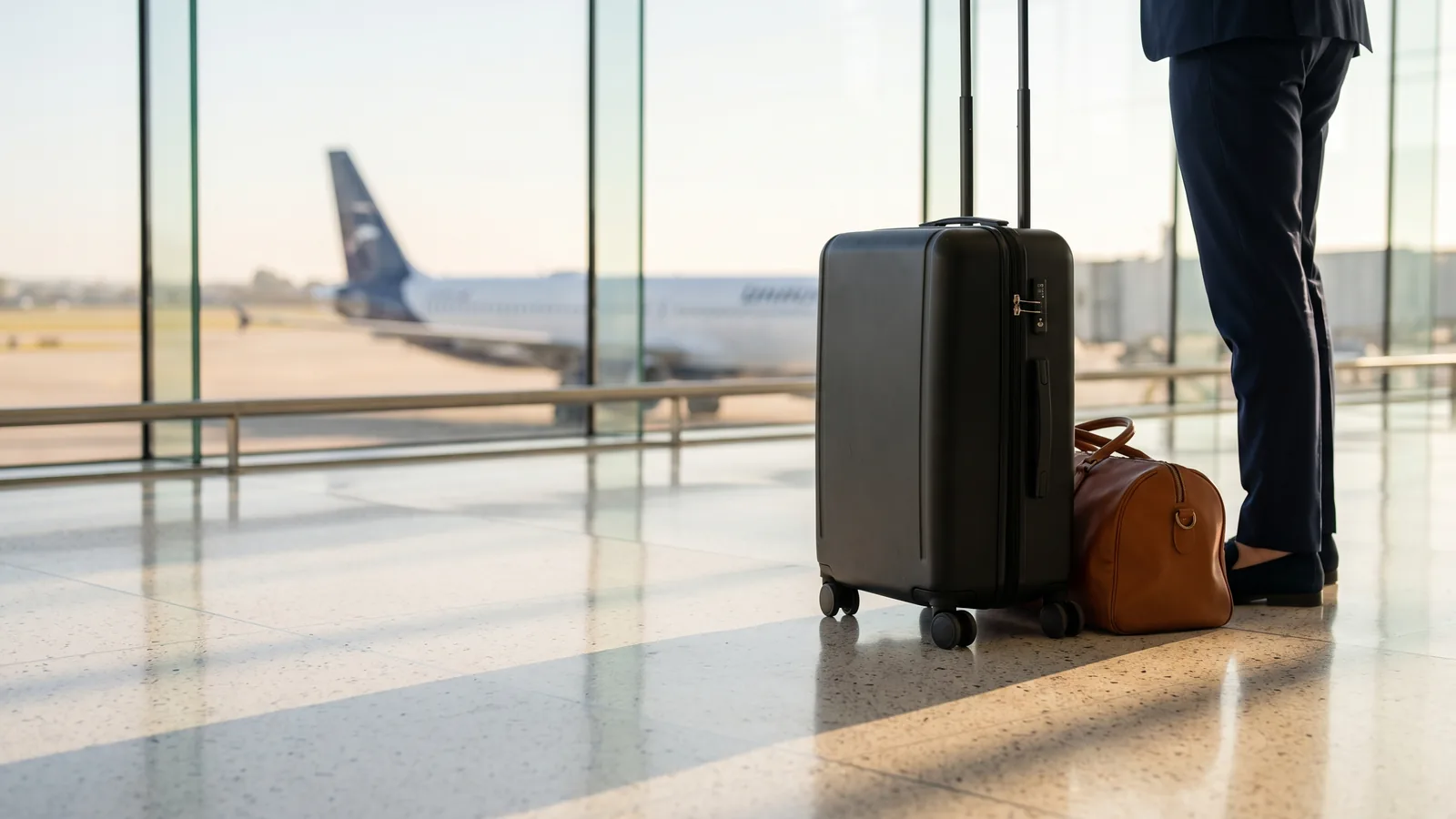 Illustrative image, AI-generated
At a glance#
| Question | Who decides |
|---|---|
| Size and weight | the airline, in the fare |
| Number of pieces | the airline, in the fare |
| Prohibited items | security regulation |
| Liquids | security regulation |
| Extra piece with status | the loyalty programme |
| Gate-checking on a full flight | the crew |
A carry-on dimension quoted without a source nearly always comes from one airline and applies to that airline alone. Few baggage rules are repeated as often and checked as rarely.
What binds every passenger#
Two areas are regulated, and both concern safety, not convenience.
The first is prohibited items. Weapons, sharp objects above defined lengths, explosives and certain chemicals may not enter the cabin. The list is broadly consistent internationally and is enforced at screening.
The second is liquids. Container size and total volume are capped, and containers must be presented in a transparent resealable bag. Medication and infant food are exempt in the quantities needed. Travellers know this rule better than any other, and together with the list of prohibited items it is the only one set by the state. Solid food passes screening, although entry rules at the destination impose their own limits, particularly on meat, dairy and fresh produce.
What is not regulated surprises most people: size, weight and the number of pieces appear in no regulation. They are contract terms between passenger and airline, which is why they differ between two flights from the same airport on the same morning.
Why the allowance belongs to the fare#
Separating the ticket price from the extras is the commercial core of modern air travel. Carry-on is the last item that stayed free for a long time, and it is now the most differentiated line in the fare for that very reason.
Three models occur. The first grants a small bag under the seat in front and nothing else. The second grants one bag for the overhead bin, frequently alongside a small personal item. The third grants two pieces, usually in higher fares or cabins.
Which model applies sits in the fare, not on the landing page. In basic fares the carry-on restriction is frequently the whole difference to the next fare up, as basic fares shows, and it is the reason a price comparison between two airlines is not a comparison until the allowance sits beside it. Two numbers belong next to every fare: the dimensions the operating carrier publishes, and its fee ladder for checking later. Together they show whether a cheap fare is cheap.
Status shifts the calculation again. Many programmes grant an extra piece or higher weight regardless of fare, and on frequent short-haul travel that is one of the few status benefits that pays on every single flight.
Why the dimensions are not comparable#
Two figures can carry the same number and mean different things. Some airlines measure without wheels and handles, others with. Some quote a maximum per side, others a sum of all three. And some place a sizer at the gate whose internal dimensions are tighter than the published values, because the sizer allows for a soft bag expanding.
A bag matching the airline’s published numbers can therefore still fail at the sizer when wheels count. Buying a centimetre or two under the maximum, and checking whether wheels and handles are included, is the reliable approach. A soft bag that compresses fits almost any sizer, a hard shell does not, so for travellers who move between carriers the soft bag is the more robust choice, even though it protects the contents less.
Frequent flyers settle the question once, with a bag that satisfies the strictest sizer among the carriers they use. It pays for itself after a few avoided gate fees and removes the uncertainty from every boarding. Weight matters less than size in most places: some airlines weigh routinely, others effectively never, and dimensions are checked far more often.
The security rules in detail#
The state-set rules are short and the most frequently misremembered.
For liquids a limit applies per container and a limit applies to the total, and both must be satisfied at once. A half-empty large container is not allowed, because the size of the container counts, whatever is in it. Medication and infant food are exempt in the quantities needed and are presented separately.
Newer scanners at some airports remove the need to separate liquids at all. That relief applies only where such a scanner stands, and it changes nothing about the return flight from another airport. Planning for the stricter version is the safe approach.
For sharp objects the limit is a length, and interpretation differs between countries more than the shared list suggests. Nail scissors that pass in one place are confiscated in another.
For electronics there is no quantity limit, but larger devices must come out for screening. Whether they can stay in the bag depends on the scanner at the checkpoint, never on the traveller.
Worked example: the fee at the gate#
A traveller books a basic fare at 79 dollars. Checking a bag at booking would have cost 30 dollars, at the airport counter 45, and at the gate 70.
Checking at booking costs 109 dollars in total. Declining and then failing at the gate costs 149, more than the ticket itself, and the 40 dollar difference comes entirely from the timing of the decision.
Meeting the dimensions and travelling without checking costs 79 dollars and saves the 30. Across a year with ten flights that is 300 dollars, and for that amount a bag that reliably fits the sizer pays for itself.
Airline fee ladders are built so that the late decision is the expensive one. Few rules in air travel reward preparation as reliably.
What happens at the gate#
The check rarely happens at security and almost always at the gate, and it is selective.
Three things trigger it: a visibly large bag, a full flight, and an airline whose ground staff receive a bonus for each oversized bag found or work to a quota.
Where the bag is too large it gets checked. The fee is the top of the ladder, and arguing changes nothing, because the agent has no discretion.
Where the flight is full and the bins are exhausted, bags are collected, and that is normally free of charge. Collection on a full flight is an operational measure and no violation, and it hits the rear rows first because they board last.
Before any handover the same reminder applies: valuables, documents, medication and batteries come out. A lithium cell may not travel in the hold at all, as power bank rules sets out, and everything else falls under limited liability.
The liability question#
For carry-on that stays with the passenger, the airline is liable only where it caused the damage. That is substantially weaker than for checked baggage, where liability applies regardless of fault up to a cap.
As soon as a bag is handed over at the gate it moves into the checked category and the stronger liability applies. A receipt at the gate is worth asking for, because a later claim is otherwise hard to attribute. Caps and deadlines sit in baggage liability.
For valuables, an exclusion or a very low cap applies in both cases. A laptop, a camera or jewellery in the hold is effectively uninsured, and travel insurance changes that only where it covers the case explicitly.
What applies when airlines change#
A trip with two airlines is governed by two rulebooks, and what applies to each segment is the operating carrier for that segment.
Two typical problems follow. The first is the bag that fitted on the outbound and does not on the return. The second is a connection with a partner whose allowance is smaller, where a single booking frequently applies the first carrier’s rule to the whole journey.
The single-booking rule is not dependable, and relying on it risks a fee at the connection. Planning against the smallest allowance among all carriers involved avoids that. Where a flight operates under another airline’s number, the attribution sits in codeshare.
When it is not worth fighting for carry-on#
Several situations argue for checking the bag instead.
On an itinerary with several connections the probability of a check exists several times over, and one gate fee exceeds the pre-booked checking charge comfortably.
Travelling with children makes the arithmetic obvious. Several people with a bag each means several checks, several bags in the bins and a substantially slower boarding.
With camera or computer equipment the case partly reverses: batteries must travel in the cabin, everything else can go in the hold, and the packing follows that split.
Where the allowance already includes an extra piece, through status for instance, the question is moot.
Conversely, checking is the wrong move when the connection is tight. A checked bag adds the wait at the belt to the arrival, and on separate tickets with a short connection it can cost the whole itinerary. A small bag is then worth more than the fee saved.
What the US market does differently#
Three features distinguish carry-on practice in the USA from most other markets, and they shape how travellers pack.
The first is that weight is rarely enforced. Most US carriers publish dimensions and either no weight limit or one that goes unchecked on domestic flights. Travellers who fly mainly within the USA and then take an international trip are regularly caught out by a weight limit they have never encountered.
The second is that the bin is contested, not the sizer. With high load factors and a long tradition of carrying on, bins fill before boarding finishes, and the practical constraint is space, not measurement. Boarding position therefore matters more than compliance, and boarding position is sold.
The third is gate-checking as routine. Being asked to surrender a bag at the jet bridge is normal, and it is usually free. Packing with that in mind, keeping medication, documents, electronics and batteries in a separate small bag, turns a disruption into a non-event.
The most common mistakes#
- Assuming dimensions from memory. They apply per airline and per fare, and last year’s figure may belong to a different carrier.
- Booking a basic fare without checking the carry-on. The allowance is often the whole difference to the next fare up.
- Arguing at the gate. The agent has no discretion, and the fee there is the highest one.
- Leaving valuables in a gate-checked bag. Valuables, documents and batteries come out before the handover.
- Assuming the same rule on the return. The operating carrier of each segment decides.
- Ignoring the fee ladder. The late decision is always the most expensive one.
- Buying a bag at the maximum. A centimetre or two under is safer, because wheels and handles count with many carriers.
Related topics#
Frequently asked questions
Are carry-on dimensions set by law?
Why do allowances differ so much?
What happens if the bag is too large?
Is weight checked?
Does a personal item count as a second bag?
What applies to liquids?
Can I bring food?
What about medication?
Does the return flight follow the same rule?
Does status help?
What happens on a full flight?
Is the airline liable for carry-on?
Sources
Clarify your case before you apply for anything
In a free strategy call, we work out which building blocks you need and in what order. Not sure how it works yet? The webinar explains it in 30 minutes.
30 minutes · online · no obligation
What we'll cover in the call
- Which card should we apply for first?
- Is it worth it for our spending?
- How much effort is it for me?