
Can I bring a power bank on a plane?
Why lithium batteries cannot travel in the hold, how the capacity tiers work, what airlines add on top, how to read the marking on the device and when a power bank should stay at home.

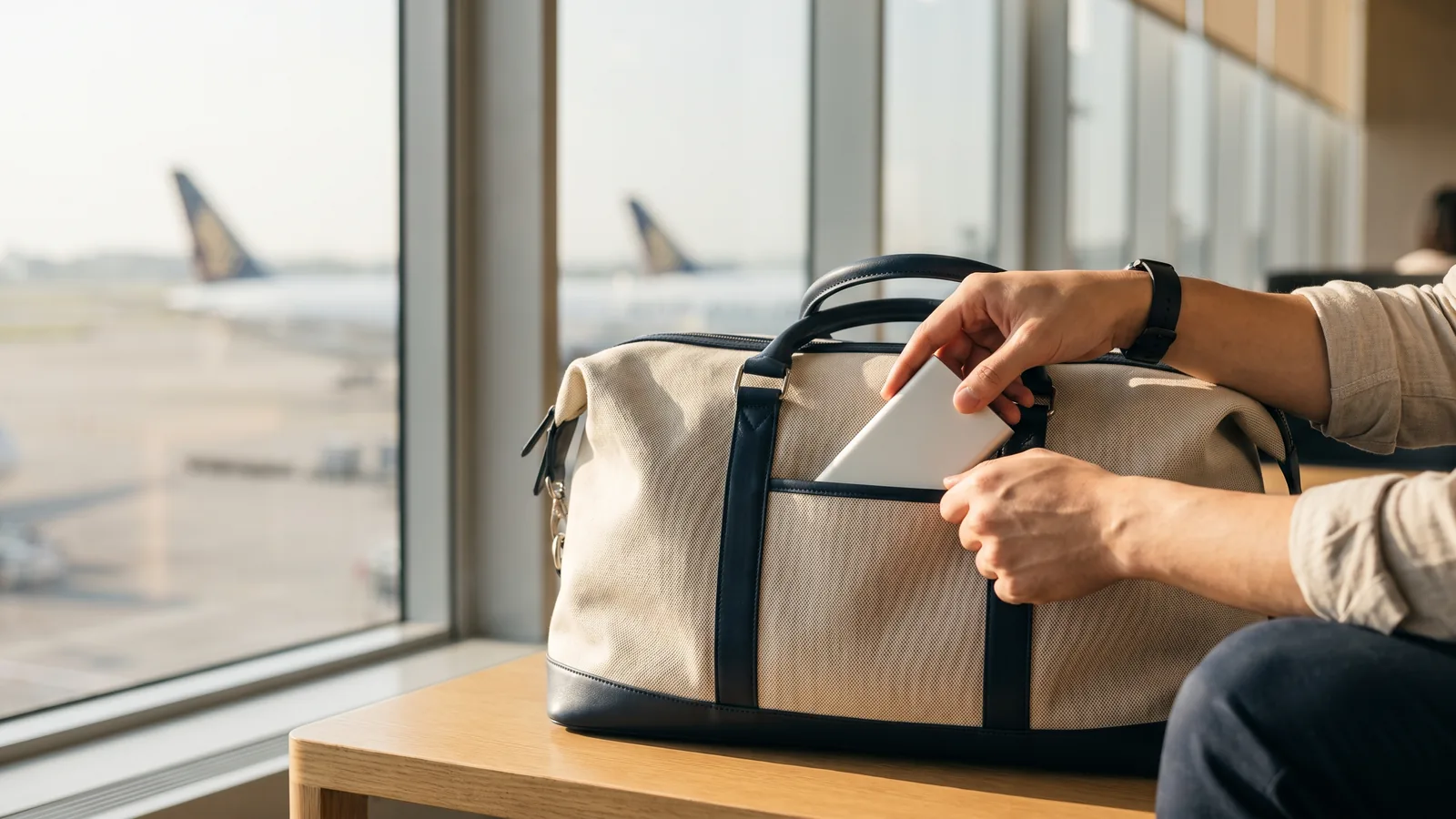 Illustrative image, AI-generated
At a glance#
| Item | Cabin | Checked |
|---|---|---|
| Power bank, small capacity | yes | no |
| Power bank, medium capacity | with approval | no |
| Power bank, very large capacity | no | no |
| Device with a built-in battery | yes | permitted, switched off |
| Loose spare battery | yes, terminals protected | no |
| Damaged or swollen battery | no | no |
The power bank is the item most likely to end its journey at a gate. The rule behind it is simple; applying it on a real itinerary is not.
Why the hold is excluded#
Lithium cells can enter a state in which they heat themselves further until they burn. The process is hard to interrupt with ordinary means and releases gases that make firefighting harder.
The entire regulation follows from that property. In the cabin somebody sits in every row and notices an incident at once, and the crew is trained and equipped for it. In the hold nobody sits. The suppression system there is designed for ordinary fires and is only partially effective against a cell in thermal runaway.
The rule is therefore not that batteries are dangerous and should be banned, but that they belong where a problem gets found. That also explains the apparently odd distinction between a laptop and a loose spare battery: a device with a built-in battery may be checked, a loose battery may not.
How the capacity tiers work#
The international framework uses three tiers, and they are the core of the subject.
Below a first threshold, power banks travel in the cabin with no special permission. Nearly every consumer device sold for charging a phone falls into this tier. Even here most airlines cap the number per passenger, commonly somewhere between two and four, and the carrier sets the exact figure.
Between the first and a second threshold, carriage is possible but only with the airline’s agreement, and frequently limited to two units. Large devices for notebooks and camera kit fall here.
Above the second threshold, carriage on a passenger flight is excluded. That mainly affects batteries for power tools, certain wheelchair designs and portable power stations.
The specific threshold values sit in the international dangerous goods framework and are adopted by airlines. For a particular flight the figures that count are the ones on the airline’s own page, because individual carriers set stricter limits than the framework requires. On trips with several flights that check belongs to each operating carrier, not once to the itinerary. A codeshare booking can put two different sets of rules on one ticket, and the rules that apply are those of the airline flying the aircraft.
How to read the marking on the device#
The governing figure is energy content in watt hours. Many power banks show only charge capacity in milliamp hours instead, and the energy content can be calculated from it by multiplying the charge capacity by the cell voltage and dividing by a thousand. The cell voltage is printed on the casing as well and is a standard value on most devices.
The printed charge capacity refers to the cells, not to the output at the socket. A power bank whose number looks larger than its usable energy is still judged by what is printed, and at the gate the print decides. Reading that marking before the trip, and noting it, takes a minute and saves an argument with the gate agent.
The other batteries in the bag#
Power banks are the best known case and far from the only one. Four groups follow the same logic and are regularly overlooked.
Loose spare batteries for cameras, tools or radios belong in the cabin and must be protected against short circuit: original packaging, a dedicated pouch or taped terminals all do the job. A loose cell rattling around among keys and coins is the very thing the rule exists to prevent.
Electronic cigarettes and vaporisers may travel only in the cabin and may not be charged. Several airlines additionally require them to stay out of the overhead bin.
Smart luggage with a built-in battery is a special case. Where the battery is removable, it comes out and travels in the cabin while the case is checked. Where it is fixed, many airlines will not accept the case at all.
Medical devices with batteries are generally permitted, often above the usual limits, but require advance notification and sometimes a doctor’s letter. The notification belongs with the booking, not with the departure day, in the same way the conditions in fare rules belong before the purchase.
Why the rules are tightening now#
The international baseline has been unchanged for years. What has changed is airline practice, for three reasons that compound.
The first is the number of devices. A traveller once carried a phone; now it is a phone, headphones, a watch, a tablet, a laptop and a power bank to feed all of them. Energy per seat has risen by a large multiple.
The second is quality spread. Power banks are sold in volume without reliable testing, and onboard incidents fall disproportionately on devices without manufacturer markings. That is why more airlines now want a legible marking on top of a value below the threshold.
The third is visibility. A cell heating inside a closed overhead bin is noticed later than one in a seat pocket. The requirement to keep the device within reach is therefore not an annoyance but the single most effective step in limiting an incident.
Using the device on board has become a rule of its own. Several airlines now prohibit charging anything from a power bank during the flight and want the device kept in sight, while others still allow it, and the differences between carriers are considerable. Countries add their own layer, since the framework is agreed internationally and its interpretation is not.
The direction of travel is clear enough. The rules will keep tightening, and a rule that applied on the last flight is not automatically the one that applies on the next.
Worked example: camera kit on a long trip#
A traveller carries camera equipment: four spare camera batteries, a large spare battery for a notebook and a medium power bank.
The four camera batteries are small and fall in the first tier but must each be protected against short circuit, in original packaging or with taped terminals. The notebook spare and the power bank probably fall in the second tier, so they need the airline’s agreement, and together they reach the common limit of two units in that tier. All of it must travel in the cabin, and the weight counts against the cabin allowance.
Moving part of the kit into the suitcase because the cabin bag is too heavy creates a double problem: the battery may not be there, and if it is found the baggage handling is delayed. If it is not found, it travels unlawfully. Cabin allowances are therefore not a comfort question when carrying equipment but a planning constraint, as carry-on rules shows.
Photographers and anyone else who travels with a lot of kit do well to keep a short list of every battery and its rating on their phone. At a gate, a calm and specific answer ends a discussion faster than anything else.
What gets checked at the airport#
Security screening is about weapons and explosives, not capacity. A power bank usually has to come out of the bag, much like a laptop, because it obscures the image, and that is all the screener wants from it.
The capacity check, where it happens at all, takes place at the gate or at check-in, and it is a spot check. It is almost always triggered by the size of the device or by a question from staff.
Where a power bank is refused there is no replacement and no compensation. The device is disposed of, and at some airports it can be stored for a fee. No claim arises, because the carriage of dangerous goods was never part of the contract.
The position differs where a suitcase is opened and a battery removed. The case travels on, the battery does not, and the loss is treated like any other baggage matter, although liability for improperly packed items is routinely excluded. How liability works otherwise is covered in baggage liability.
What happens during an onboard incident#
For the rare case that a device overheats in flight, the cabin is prepared, and knowing that takes the drama out of the subject.
The crew carries equipment intended for this and is trained in its use. The procedure is to cool the device and contain it, and it works. The critical precondition is that somebody notices the beginning, which is what every storage requirement is aimed at.
The right passenger response is short. Anyone who notices a device heating strongly, smelling or deforming calls the crew and does not attempt to extinguish it or put it in a bag. Anyone who loses a phone between the seat and the backrest stops adjusting the seat and reports it, because the mechanism can crush the cell. Both instructions sit in the safety briefing and are rarely read.
When it is not worth carrying one#
Where the device is damaged, the answer is clear. A swollen casing, a deformed cell or a device that runs unusually warm must not travel, and that case merits no discussion.
Where the capacity is illegible, it will probably be refused at the gate. Staff who cannot classify a device have no reason to wave it through, so a power bank whose printing has rubbed off is effectively worthless for travel, however well it still charges.
Where the flight is short and the seat has a power outlet, the benefit is small. Cabin fittings depend on the aircraft type, and how to establish that before booking sits in finding your aircraft.
And where the cabin bag is already at the weight limit, a large power bank is a poor trade. A wall charger weighs a fraction.
The most common mistakes#
- Putting the power bank in the suitcase. It goes in the cabin, without exception.
- Trusting the framework. The airline is free to be stricter, and many are.
- Carrying a device with no legible marking. Without one, a refusal at the gate is the likely outcome.
- Carrying loose spares unprotected. Taped terminals or a pouch for each battery is all it takes.
- Taking a damaged battery. A swollen or deformed cell may not board at all.
- Forgetting the weight. A large power bank eats a noticeable share of the cabin allowance.
- Reusing last flight’s rule, or checking only one airline on a codeshare itinerary. Requirements change often, and the operating carrier’s rules apply to each segment separately.
Related topics#
Frequently asked questions
Can a power bank go in checked baggage?
How many may I carry?
Where is the capacity shown?
What about a power bank with no marking?
May I use it in flight?
What about the overhead bin?
Does this apply to laptop batteries?
What about damaged batteries?
Is it checked at security?
What if it is refused at the gate?
Are the rules the same worldwide?
Does it count towards the cabin bag weight?
Sources
Clarify your case before you apply for anything
In a free strategy call, we work out which building blocks you need and in what order. Not sure how it works yet? The webinar explains it in 30 minutes.
30 minutes · online · no obligation
What we'll cover in the call
- Which card should we apply for first?
- Is it worth it for our spending?
- How much effort is it for me?