
My bag did not arrive, what do I do at the airport?
Why the report at the airport is the only reliable step, what the file reference does, how interim expenses are reimbursed in the United States, when a bag counts as lost and when the effort is not worth it.

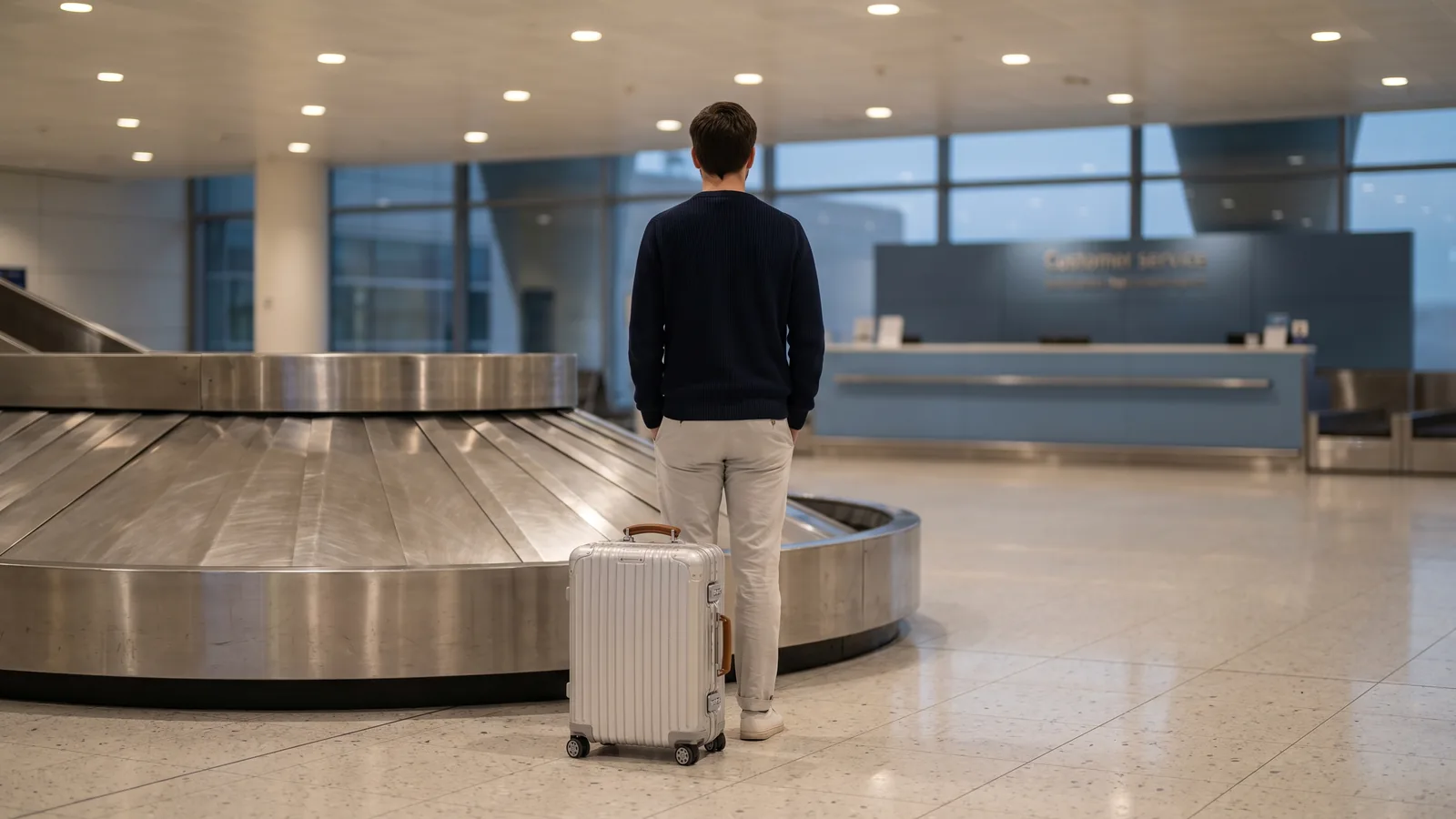 Illustrative image, AI-generated
At a glance#
| Step | When | Effect |
|---|---|---|
| Report at the airport | before leaving the claim area | opens the file |
| File reference | at the report | basis of every later claim |
| Delivery address given | at the report | makes delivery possible |
| Interim purchases with receipts | from day one | reimbursement of what is needed |
| Checked bag fee refund | after the stated delay | separate from expenses |
| Change to lost | after a set period | settlement instead of search |
Why the first hours decide#
Of all the disruptions on a trip, a missing bag has the clearest procedure. There is one fixed first step, one number everything hangs on, and one period after which the claim changes character. Knowing those three things means losing no time at the airport on questions nobody can answer.
A missing bag is almost always a delayed bag and only rarely a lost one. The line between the two decides which claim applies, and it starts with a report that can only be made at the airport. Treated as a procedure, the case is rarely difficult: the report establishes it, the file reference carries it, and the receipts decide it. Reporting immediately, buying what is needed and photographing every receipt gets the cost of the wait reimbursed in nearly every case.
Leaving the claim area without reporting gives up the simple route. From then on the traveller has to prove the bag was missing at all, and that proof is hard to assemble without a file.
The report itself takes a few minutes. It records the description of the bag, the tag number, a delivery address and a phone number, and out of it comes the file reference. That number is the key to every later enquiry, every reimbursement and every letter, and it deserves a photograph on the spot.
What the file does#
It fixes the date#
The file records the event and it starts the search, which makes it the only document in this process that counts. Deadlines run from a date, and the file holds that date. Without it, any dispute starts with an argument about when the bag went missing.
The file also records which airline operated the last segment. On connecting itineraries that is the entry that decides who takes the report.
Finally it records the contents in outline, an entry that matters later, when a delay turns into a loss.
It opens the search#
With the reference number, tracing runs automatically. Bags are matched worldwide against descriptions, and most reappear within a few days. A photo of the bag speeds up matching considerably, because it replaces a description that otherwise sits among twenty similar entries.
The search reaches the traveller through the address given. Moving on before the bag arrives means updating that address in time, which can be done online through the reference. Delivery to a hotel the traveller has already left costs further days, and the hotel usually accepts the bag without checking.
Tracing does not provide a reliable forecast. The systems show the last known scan point, and no delivery date follows from that, so planning means assuming the bag will not arrive tomorrow. Checking the file online once a day beats calling: the phone agents read out the same status line that appears in the portal, and the time spent on hold is the most expensive minute of the whole procedure.
Group bookings need one file per bag. When several bags from one party are missing, a single combined report sounds efficient and later means only one person can claim.
Interim expenses and the bag fee refund#
Reimbursement covers what the trip requires, and what is required depends on the trip. A week by the sea calls for different things than two days with a meeting in the morning.
Reasonable means the normal price level, neither the cheapest nor the most expensive. Buying at premium brands leads to a reduced settlement, and buying nothing out of caution leads to nothing.
Reimbursement runs against receipts, and every receipt deserves a photograph as it appears, because paper gets lost on a trip. Toiletries bought on the evening of arrival and a shirt for the next morning are the typical first purchases, and both are easy to justify on any trip.
Separately from the expenses, the fee paid to check the bag is refundable once the delay passes the point set by federal rule. That refund is not automatic and has to be requested with the file reference, and it is the part most often left on the table.
Arriving at home is a special case. Someone reaching their own city has little need, because their own clothes are in the wardrobe, and claims for replacements at home are almost always declined, understandably so.
Worked example: three days without a bag#
The bag in this example is missing on arrival and delivered on the third day. The trip is a business trip with two meetings.
| Item | Reimbursable | Reason |
|---|---|---|
| Toiletries on arrival day | yes | needed immediately |
| A shirt for the meeting | yes | purpose of the trip |
| Underwear for three days | yes | length of the trip |
| A suit | partly | only after a longer wait |
| Shoes | rarely | only for a specific occasion |
| A replacement suitcase | no | the bag is being delivered |
Underwear for three days shows the principle. What is reimbursed is the need created by the wait, and that need grows with every day.
The suit is the most common point of dispute. A suit on day one is reduced, a suit on day four is more often accepted, and the difference lies purely in the duration. Shoes are where most claims fail. They are almost never accepted, because the pair being worn travelled along, and the exception is an occasion that strictly requires different ones.
Trips with a specific occasion, a wedding or a conference with a dress code, sit outside the usual measure. The need is higher than the length of the trip suggests, and it is recognised when the occasion is named and evidenced in the letter. An invitation as an attachment is enough.
Sports equipment and child seats are another special case. Replacements are rarely available to buy at a destination, and renting locally is the accepted solution. The rental invoice is treated like a replacement purchase.
The list for the claim reads best by day, not by category. The chronological order shows the growing need, and the growing need is what the review looks at.
From delayed to lost#
After a set period from the report, the case changes. A delayed bag becomes a lost one, and with it the nature of the claim changes. Until then the subject is the cost of waiting; afterwards it is the value of the contents, and the liability limits apply, as baggage liability limits describes.
The change does not happen on its own inside the airline. The traveller triggers it by requesting settlement of the contents in writing once the period has passed.
Settlement of the contents needs an inventory. A photo of the packed bag is a clear advantage here, and an inventory written from memory underestimates the value every time. An inflated inventory does not raise the settlement either; it raises the number of questions, and every question adds weeks.
Interim expenses continue until the change. They do not stop because a period is running, and they are reimbursed for the time in which the loss is already being discussed.
After the change, depreciated value applies instead of replacement cost. A three-year-old jacket is not replaced as a new one, and the liability limit caps the total on top of that.
Some bags never surface although the scan shows them loaded. Those cases end in a depreciated-value settlement and take months, and the effort pays only with contents to match. Valuables belong in the carry-on for that reason.
A damaged bag is a separate matter. It is settled under liability and carries its own, shorter deadlines, as damaged baggage deadlines describes, while a missing bag follows a different route.
When two airlines are involved#
On a connecting itinerary the bag is missing at the destination but was usually lost at the connecting airport. The report is still made at the arrival airport.
The operating carrier of the last segment takes the report. The claim itself typically goes to the airline the ticket was bought from, and both belong in the same letter.
On separately booked tickets that chain falls apart. Responsibility ends with the first ticket, as separate tickets describes.
Codeshare flights are a related trap. One airline is printed on the ticket, another operated the flight, and the report names the operator, as codeshare describes. Writing to the wrong one costs weeks.
When it is not worth the effort#
The claim carries little in these cases:
- On a delay of a few hours. Barely any need arises, and a letter is not worth writing.
- Without a report at the airport. The proof is almost impossible to assemble later.
- Without receipts for replacements. A list without them is declined.
- For valuables in checked baggage. Liability for them is limited in any case.
- On very short trips. Flying back the next day and receiving the bag at home leaves no need that can be claimed.
What helps before the trip#
Three habits reduce the damage, and all three cost a few minutes before departure.
A photo of the packed bag and of the baggage tag evidences both appearance and contents, and it speeds up the search. What is needed for twenty-four hours goes in the carry-on: medication, a change of clothes and the documents for the first meeting.
The third habit is a look at the connection time before booking. Short connections are the most common reason a bag misses the transfer, as connection time describes.
Frequent flyers keep the file reference and the receipts in one place from the first hour. A claim assembled in one sitting is answered faster than one assembled from three sources weeks later.
The most common mistakes#
- Going home without reporting. The report has to be made before leaving the baggage claim area.
- Not securing the file reference. A photo of the report on the spot keeps it safe.
- Buying nothing out of caution. What the trip needs is reimbursed, as long as the receipts are kept.
- Buying too expensively. Premium prices get the claim reduced to the normal level.
- Forgetting the checked bag fee refund. It comes back only when requested separately, with the reference.
- Checking valuables. Liability for them is limited, and the carry-on is the safer place.
Related topics#
Frequently asked questions
What is the first step at the airport?
What is the file reference?
How long do I have to report?
Can I buy replacements right away?
Does the checked bag fee come back?
When does a bag count as lost?
Who is responsible when two airlines are involved?
Does the card's coverage pay as well?
What if the bag is delivered to a hotel?
Do I need receipts?
What helps the search?
Does this apply to bags taken at the gate?
Sources
Clarify your case before you apply for anything
In a free strategy call, we work out which building blocks you need and in what order. Not sure how it works yet? The webinar explains it in 30 minutes.
30 minutes · online · no obligation
What we'll cover in the call
- Which card should we apply for first?
- Is it worth it for our spending?
- How much effort is it for me?