
Why was I turned away at the lounge desk?
The six reasons for a refusal, the one question worth asking at the desk, how to rescue the visit elsewhere, and when a complaint actually achieves something.

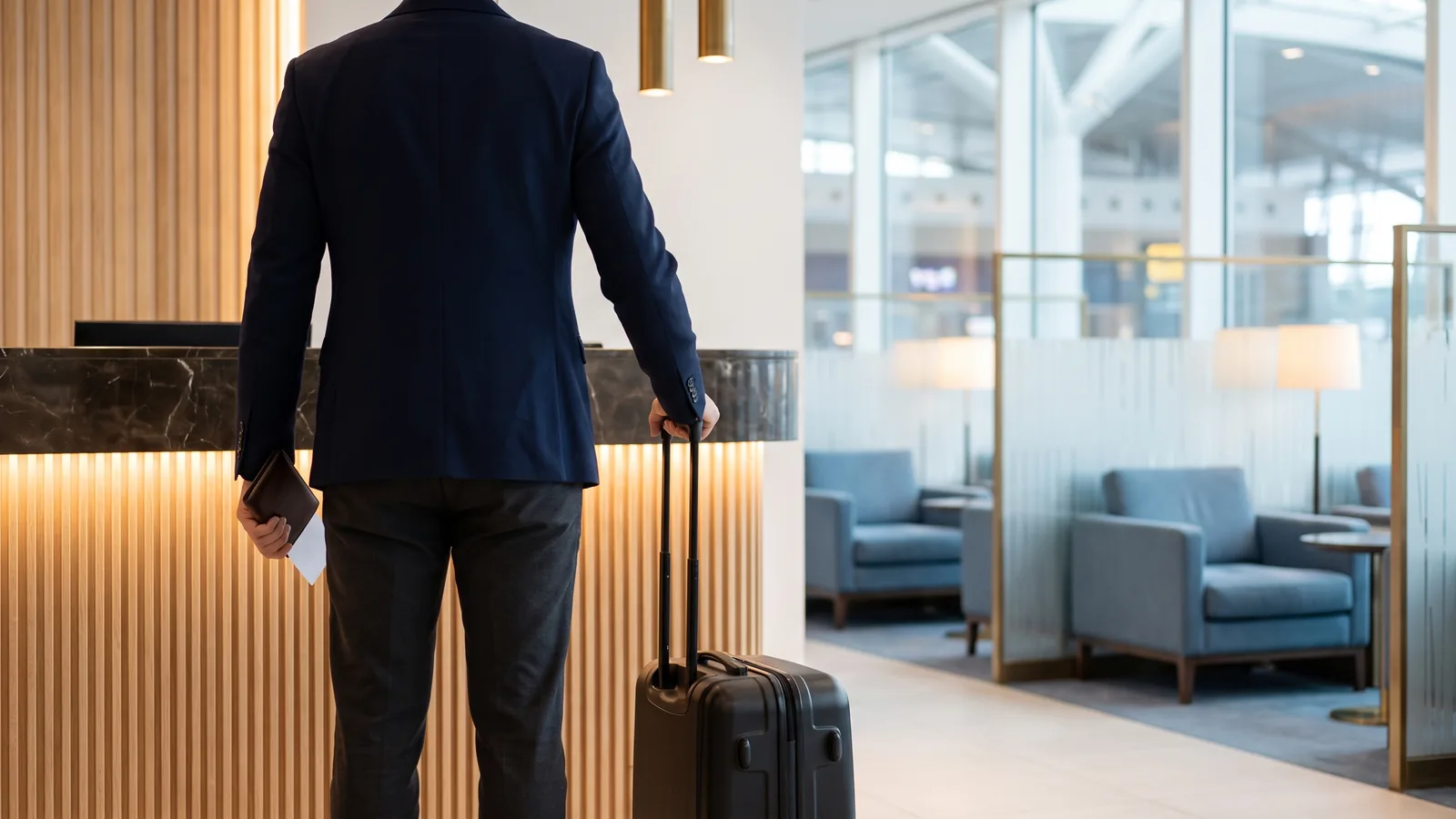 Illustrative image, AI-generated
At a glance#
| Cause of the refusal | Solvable on the spot | What helps |
|---|---|---|
| The lounge is full | partly | try again later, another lounge |
| Entry window not open | yes | wait it out, then enter |
| Wrong terminal area | rarely | settle before security |
| Access route not recognised | no | buy entry or skip it |
| Guest rule | partly | buy the guest in where permitted |
| Boarding pass does not fit | partly | present the correct one |
Why a refusal is rarely personal#
The person at the desk is working through a list. The list belongs to the operator of the lounge, and it differs from the overview in your frequent flyer account. Nearly every refusal comes out of that split: the programme says access exists, the lounge says it does not apply here or now, and both are describing different rules.
At the door, two things follow. The answer at the desk is final for today, and it says nothing about whether the access exists in general.
Keeping those apart saves the argument and gets you to the useful question faster, which is the cause of the refusal and whether it will still apply in an hour. A refusal is almost never a verdict on the person, only a rule being applied on the operator’s behalf.
The six causes#
Six causes cover nearly every case. They differ mainly in whether they can change within the hour, and the right reaction follows from that. Three of them resolve with time or money, three do not. In most lounges the desk has no authority to depart from the rule in any of them, and an exception would be hard to justify to the people waiting behind you.
The lounge is full#
Capacity limits apply regardless of the access route. They are applied in an order, and buyers and members sit near the front of it.
Occupancy changes quickly, though. Half an hour later the same lounge often looks quite different because a departure wave has passed through, so a second attempt is the most effective step available and costs nothing beyond time that had to be filled anyway. The lounge next door is the other option. At large airports several operators recognise the same access route, and occupancy spreads unevenly across a terminal.
The entry window has not opened#
Many lounges admit passengers only a few hours before scheduled departure. Turn up earlier and you are refused without anything being wrong with the access. The window follows the scheduled departure, not the actual one, so a delay does not usually shorten it.
Of the six causes this is the most pleasant, because it disappears on its own and the wait can be spent in a seat nearby. The reverse also holds: arriving very early means planning the wait and entering at the right time, which does not shorten the stay, it only moves it.
The wrong terminal area#
Access applies to a specific lounge in a specific area, and after security a change is often impossible. The wrong area is the most irritating cause because it can barely be solved on site. It belongs to preparation, not to the airport routine.
At large hubs several lounges of the same network sit in different areas. The choice is made walking through security, and afterwards it is fixed. Settling it before departure takes two minutes: the terminal map shows which lounge sits behind which checkpoint, and after that it is only a matter of walking.
The access route is not recognised#
A lounge may recognise a membership only at certain times, or not at all, while the same membership opens a door two gates away without trouble.
An unrecognised access route is final, and it is the only one of the six causes where discussion achieves nothing, however polite or persistent. What remains is buying an entry or skipping it. For planning, that means reading the rule of the specific lounge beforehand. Which routes exist at all is set out in who gets into the lounge.
The guest rule#
The operator’s rule overrides your programme. Some lounges admit no guest, some one, some several against a fee. The usual case is a couple travelling on a single access route, where the surcharge decides whether both get in. It is rarely negotiable at the desk. Children count as guests with most operators, sometimes with an age limit below which they enter free.
Blackout periods belong in the same category. Some lounges close to individual access routes at peak times and reopen in the afternoon without anything changing in the membership. Regulars at the same airports learn these patterns quickly. Whether the whole exercise pays is approached from another direction in when status gets you nothing.
The boarding pass does not fit#
Access hangs on the flight, not on the day. A boarding pass for a later flight may not open the door even though the same person is standing there, and on connections the next departure usually counts. Without the second segment’s boarding pass there is nothing to present.
The same question comes up after a rebooking, because access depends on cabin, status or membership, and a rebooking can change all three. Mobile boarding passes make it worse by often showing only the next segment. A screenshot of both segments solves that, and it works without a signal.
A rebooking onto another airline sometimes removes access entirely, even though the ticket became more expensive. It pays to ask about the lounge during the rebooking itself, in the same way upgrade mechanics describes seat assignment.
The one question that helps#
Instead of contradicting, ask a factual question: which cause applies, and will it change within the next hour?
The answer sorts the case immediately. Capacity and entry windows change, terminal area and recognition do not, and the guest rule and the boarding pass hang on something that can be shown. Asking for the cause sorts the matter in two minutes.
Tone counts for a lot. A traveller who does not attack the rule is more likely to be pointed towards the lounge next door, and that hint is worth more than any argument. Asking about another lounge in the same area helps as well, since staff know the neighbourhood and usually share it once it is clear that no argument will follow.
Worked example: two refusals on the same day#
Two travellers are refused at the same lounge. One arrives too early, the other holds a membership this lounge does not recognise.
| Too early | Not recognised | |
|---|---|---|
| Cause changes | yes, with time | no |
| Second attempt sensible | yes | no |
| Buying entry | not needed | the only remaining route |
| Alternative lounge | often unnecessary | the first option |
| Effort | waiting | searching or skipping |
Without first asking for the cause, both cases get the same treatment, and in one of them that is a pure waste of time. A second attempt is cheap, but it only makes sense where something can change within the hour, which is the case for the early arrival and never for the unrecognised membership. For the second traveller, an alternative lounge is almost always faster than any clarification with the membership provider.
A boarding pass issued by a travel agency occasionally carries no status marking, which can look like a third refusal in the making. The programme card then closes the gap, because the desk combines both records.
When no lounge is open to you#
Most of a lounge’s value is replaceable. A seat with a power socket, a quiet corner away from the gates and a café with a table cover the majority of it, and a coffee at a table costs less than a day pass. Someone who only wants to work needs a seat, a socket and quiet, and all three exist at most airports.
At many airports the quietest areas sit at gates whose flights leave hours later. They are rarely occupied and cost nothing. Regulars connecting through the same airport memorise two such spots, and after that the lounge is a comfort, no longer part of the plan.
For longer waits many airports also rent quiet rooms and work spaces. They do not replace a lounge, but they solve the problem the lounge was wanted for.
At airports with few long-haul departures the quietest hours fall in the early afternoon. A wait planned into that window makes the lounge less necessary than it first appears.
When it is not worth complaining#
In these situations a complaint costs more effort than it can return:
- Capacity. A full lounge breaks no promise, and the complaint reaches nobody who can change it.
- The entry window. The rule sits in the conditions and can be read before the visit.
- The guest rule. The operator sets it, not the programme that sold the membership.
- A one-off deviation. A single incident cannot be evidenced and produces a standard reply.
Repeated failure is different. Where a lounge keeps refusing to honour a promised access route, that belongs with the membership provider, and there something occasionally changes. The complaint should name date, time, airport, lounge and the reason given. Without those five details any answer stays generic and the case ends without a result.
What can be settled in advance#
Three details prevent most refusals, and they sit in the rule of the specific lounge, usually on the same page: the entry window before departure, the guest rule with its surcharge, and the access routes that lounge recognises. Note them once for your home airports and you will not need to look them up again for years. Arriving with those three in mind means an expectation that matches what happens at the desk.
A prepaid reservation is a different matter. There a contract exists for a stated period, and a refusal usually leads to a refund, with a chargeback needed only as a last step.
The most common mistakes#
- Arguing at the desk. Ask for the cause first; the decision about what to do next follows from the answer.
- Giving up immediately. When the lounge is full, half an hour often changes the picture, so a second attempt is worth making.
- Arriving too early. The entry window is published in the lounge rule and can be read the evening before.
- Ignoring the terminal area. Where the lounge sits has to be settled before clearing security, because afterwards the choice is fixed.
- Assuming guests are admitted. The operator’s guest rule decides, and it belongs in the planning before the trip.
- Treating a membership as a guarantee. A membership conveys access to the door, never a guaranteed seat behind it.
Related topics#
Frequently asked questions
Why am I refused when I have access?
What should I ask at the desk?
Does showing my status card help?
Can I buy my way in when access does not apply?
Do I get a refund when refused?
Does a refusal apply all day?
Why can my companion not come in?
What if the lounge is in the wrong area?
Is a complaint worth making?
What helps when no lounge is open to me?
Does a delay change access?
How do I know in advance whether it will work?
Which flights are really in your spending?
In a free strategy call, we translate your spending into your actual routes and travel dates. Want to see the number first? The calculator shows it in about 30 seconds.
30 minutes · online · no obligation
What we'll cover in the call
- Which airline programs fit our routes?
- How many flights are realistic for our spending?
- What do taxes and fees cost on award flights?