
How do I get into an airport lounge?
The four routes into a lounge, why entry is decided at the desk rather than at purchase, what cabin, status and membership each do, and when the whole exercise is not worth it.

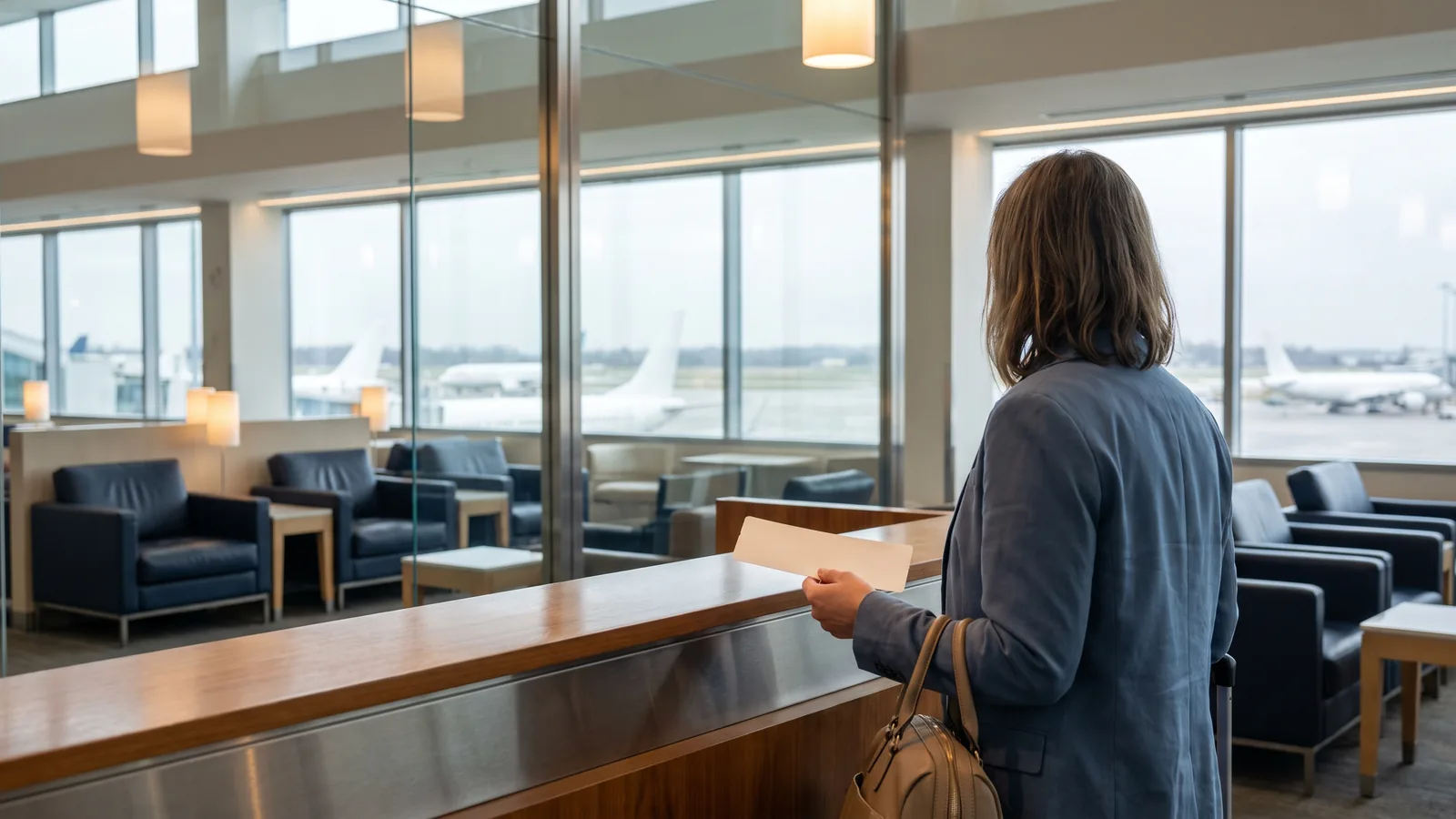 Illustrative image, AI-generated
At a glance#
| Route | Who decides | Typical limit |
|---|---|---|
| Booked cabin | the airline operating the flight | applies to that flight only |
| Elite status | the programme and the alliance | only from a higher tier |
| Lounge network membership | the operator of the lounge | entry window, guest rule, capacity |
| Buying at the door | the operator of the lounge | only while space remains |
| Airline invitation | the issuing airline | tied to one booking |
Why entry is decided at the desk#
A lounge rarely belongs to the airline somebody is flying. It belongs to another carrier, an airport operator or a contractor, and that operator sets the rule for entry.
The split produces the most common argument at reception. Your programme says access exists, the lounge says it does not apply here, and both are right because they are quoting different rules. For planning, the useful question is whether this lounge at this airport recognises that access today. Whether a status offers lounge access in general settles very little. The distinction sounds pedantic, yet it is the difference between a quiet hour and a conversation at the desk.
An airline may also operate no lounge of its own at an airport and contract a third party instead. Access then applies to that contracted lounge and to nothing else, even when three others stand beside it. At its home airport the same airline often runs several lounges with graded rules, and which one opens depends on the tier, not on the brand printed on the ticket.
The four routes#
All four routes can exist side by side, and none excludes another. A status holder flying in a premium cabin uses whichever route opens the better lounge at that airport.
The booked cabin#
Flying in a premium cabin usually opens the lounge of that airline, or the lounge it has contracted at that airport. Access hangs on the boarding pass for that flight, not on the person. It ends with the flight and does not extend to a later flight the same day in a different cabin.
Connections need a second look. Entry usually follows the cabin of the next departure, whatever the long haul leg was, so the entitlement can change while changing planes.
Elite status#
Status opens lounges only from a certain tier, and the lower tiers of most programmes open nothing at all, not even on the airline that issued the status.
Inside an alliance, access travels on the alliance tier, and the programme’s own name for it is irrelevant. Whoever carries the higher alliance tier gets in at partners. Status also works in the cheapest cabin, though not at every lounge, and that is where its value lies. What it does not do is covered from the other side in when status gets you nothing.
A connection inside the alliance keeps the tier alive as long as the next flight is operated by a member. A leg outside the alliance breaks the chain, and the lounge at the connecting airport will ask about precisely that.
The membership#
Lounge networks sell memberships that open doors at many airports without being tied to an airline, and they often come attached to a credit card. Membership is the most fragile of the four routes, because each individual lounge adds its own conditions on top: entry windows, guest rules and blackout times.
Some memberships count visits instead of granting unlimited entry. Access is then certain but finite, and a companion consumes a second visit. Whether a membership pays for itself depends on the number of visits per year, and the calculation works like annual fee maths.
Buying at the door#
Many lounges sell single entries, frequently cheaper online in advance than at reception. Buying is the only route that works without status, cabin or membership. Airline operated lounges sell single entries far less often than independent ones.
Only free capacity is sold. When a lounge fills up, this route closes first, before any member is turned away. The price at the door is almost always above the price in advance, so deciding on the spot means paying a surcharge for the privilege, while a reservation removes the capacity risk at the same time.
Where entry fails#
Five reasons explain nearly every refusal, and none of them is about the person.
The lounge is full. Capacity limits apply regardless of route, and they hit the routes in a fixed order. Buyers are turned away first, then members, then status guests, and last the premium cabin passengers the lounge is operated for.
The entry window. Many lounges admit only a few hours before departure. Arriving earlier means waiting outside, though a delayed flight does not automatically end the entitlement.
The wrong terminal. Access applies to a specific lounge in a specific area, and after security the area often cannot be changed.
The wrong boarding pass. Access hangs on the flight, not on the day. A later boarding pass the same day does not open the same door.
The guest. The operator’s guest rule overrides your membership, and an extra traveller is the most common trigger for a discussion. Guest rules can differ between two lounges of the same network at the same airport, and most operators count children as guests under the same rule, sometimes with an age limit below which they enter free. It is the question skipped most often and the one behind most refusals.
Domestic flights and rebookings cause their own surprises. Many programmes separate a simpler domestic lounge from the international one, and the tier decides which applies. A rebooking onto another airline can change the cabin, the status recognition and the boarding pass all at once, and with them the access. Lounges after landing exist at some airports, mostly for long haul arrivals, but they run under separate rules and rarely fall under the same right as the departure lounge.
Being turned away still leaves options, and they are set out in what to do when a lounge turns you away. Walking back to the gate is only one of them.
Worked example: membership or single entries#
A traveller flies six times a year and could use a lounge on every flight. The comparison runs on two quantities: the number of visits taken and the price of one entry.
| Membership | Single entries | |
|---|---|---|
| Cost | annual, regardless of use | per visit |
| Predictability | high, while the lounge recognises it | high, while space remains |
| Risk | the lounge does not accept the membership | the lounge is full |
| Guests | per the operator’s rule | freely purchased |
| Breaks down at | few visits taken | many visits a year |
The table names no prices, because they differ by airport. What it shows is the quantity that has to be measured: the number of visits that really happen, as opposed to the number that seem possible when the membership is advertised.
For frequent travellers the sum tips early. Above a double digit number of visits a year the membership is almost always cheaper, provided the lounges on those routes recognise it. A special case looks open and is not: some lounges accept a membership only against a surcharge, so the membership buys a discount and no more.
Time is the other cost that gets overlooked. A lounge visit pays off only above a certain stay, and a traveller arriving close to boarding buys a service they will not use.
What a lounge is not#
Access is not a right to a seat, not a promise about the catering and not a guarantee of quiet. Operators change opening hours, furnishing and food without notice, and rarely explain the changes. A traveller heading for a particular lounge because of one feature should expect it to look different next time.
Nor is access an advantage during disruption. Rebookings run through the airline, and in many cases the lounge cannot make them at all. Waiting in a lounge during a cancellation costs nothing and gains nothing; what helps is in what to do when a flight is cancelled.
For status travellers entry is only part of the package anyway. The larger part sits in seating, baggage and rebooking, and how it is assigned is shown in upgrade mechanics.
What a lounge does reliably provide is a seat with a power socket, a toilet without a queue and drinks without a till. Expectations set there are rarely disappointed.
When it is not worth chasing lounge access#
Six situations in which the effort is not worth it:
- Short connections. A few spare minutes get spent walking to the lounge, with none left for sitting in it.
- Small airports. Where only one lounge exists, it is regularly full at peak times.
- Travelling as a pair or more. As soon as guests are added, the sum tips towards single entries.
- Flying extra segments for the status. Additional flights bought for access cost more than any entry is worth.
- A card held mainly for the membership. Paying an annual fee for that means counting visits, not reading the advertisement.
- Overnight flights. A traveller planning to sleep after take off gains little in a lounge, and the hour before is survivable at the gate at almost any airport.
At some airports, on the other hand, the lounge is the quietest place in the terminal. There even a short wait pays off, and the access question is worth asking for a single hour.
Checking before departure#
Three questions are enough and take a few minutes. Which lounge sits in the area of the terminal your flight departs from? Which routes does that specific lounge recognise? What entry window and guest rule apply there?
With those answers you know before walking to reception whether entry will work. Without them you find out at the door, and the answer there is final. With them, the procedure at reception is usually no more than a boarding pass and proof of access. A screenshot of the lounge’s own wording helps as well: it shortens any discussion to a glance, and it works offline.
Rules of individual lounges change more slowly than almost anything else in this business. A traveller on the same route regularly settles the question once, and a short note per terminal, two lines per lounge, saves it on every later trip.
The most common mistakes#
- Treating your own status as decisive. The operator of the specific lounge sets the rule, and that rule is the one to read.
- Arriving far too early. Many lounges admit only within a window before departure, which is worth checking in advance.
- Overlooking the terminal area. Where the lounge sits has to be settled before clearing security, because the area often cannot be changed afterwards.
- Planning for guests who are not admitted. The operator’s guest rule overrides any membership.
- Seeing a membership as a guarantee. It is an offer that ends at capacity.
- Flying extra segments for access. A single entry, bought when it is needed, costs a fraction of that.
Related topics#
Frequently asked questions
Which four routes lead into a lounge?
Does my status work on partner airlines?
Does the cabin matter or the programme?
Can I bring a guest?
Why am I turned away despite a membership?
Are there lounges after landing?
How early can I get in?
Does access apply on domestic flights?
What about children?
Can I simply buy entry?
Do I lose access after a rebooking?
Why do online sources contradict each other?
Which flights are really in your spending?
In a free strategy call, we translate your spending into your actual routes and travel dates. Want to see the number first? The calculator shows it in about 30 seconds.
30 minutes · online · no obligation
What we'll cover in the call
- Which airline programs fit our routes?
- How many flights are realistic for our spending?
- What do taxes and fees cost on award flights?