
How do I get upgraded on a flight?
The five routes into a higher cabin, why the fare often outweighs the tier, how bidding and mileage upgrades relate, and what actually happens at the gate.

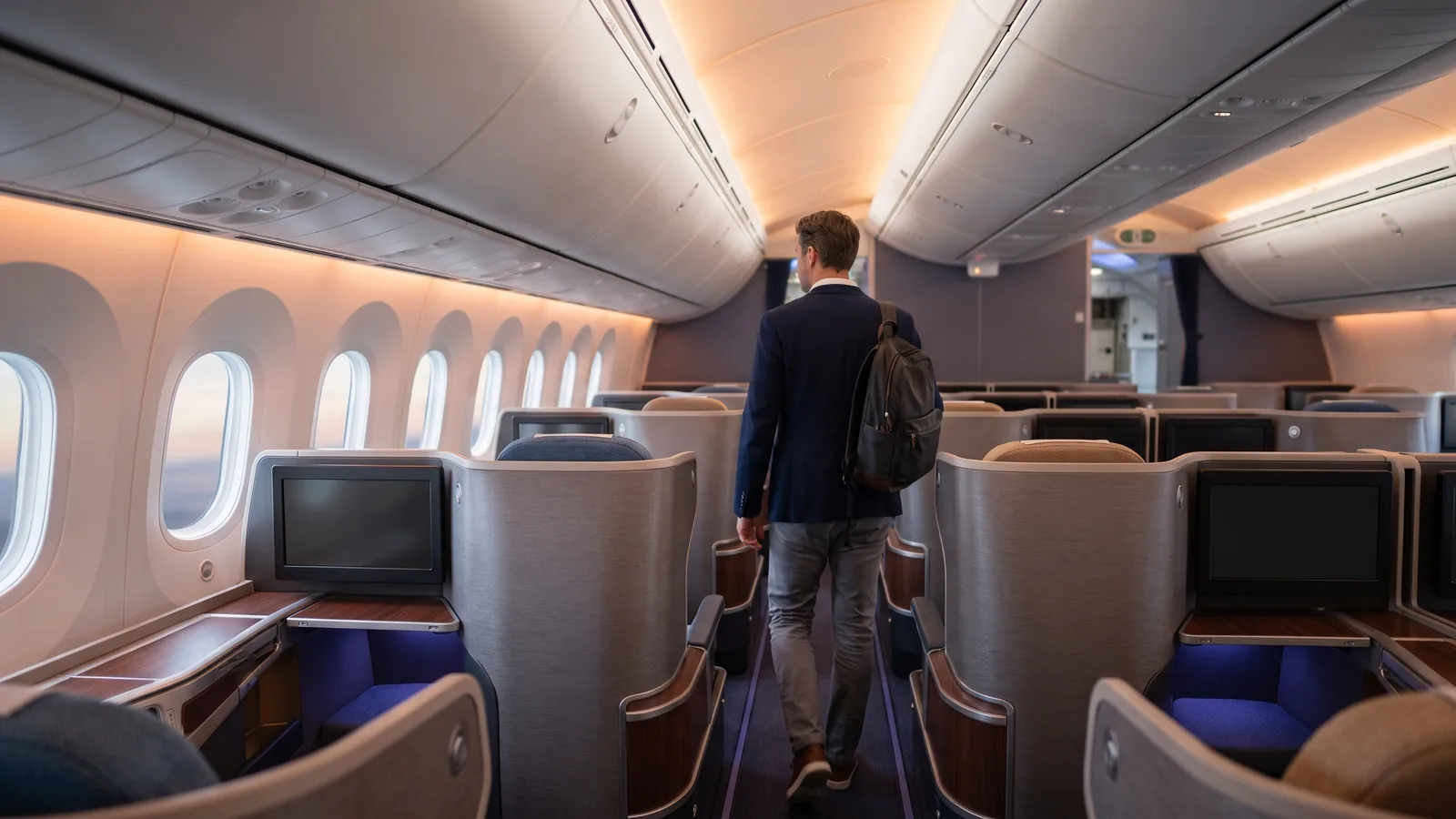 Illustrative image, AI-generated
At a glance#
| Route | Who decides | Timing |
|---|---|---|
| Buying at booking | the traveller | immediately |
| Buying after booking | the airline | until shortly before departure |
| Bidding | the airline | usually one or two days ahead |
| Miles or certificate | award space in the premium cabin | from booking, often late |
| Operational move | the handling agent | as boarding closes |
Why upgrades are getting rarer#
For an airline a higher cabin is a product with a price, and every seat given away is a seat that was not sold. That calculation explains the whole development of recent years. Where a gate agent once moved people, a booking portal now shows an offer.
For travellers the question is no longer how to get an upgrade but which of the five routes is open in a particular case. Older advice stopped working for the same reason: it comes from a time when empty seats were a distribution problem and not yet revenue.
Load adds to it. Premium cabins have become smaller and are sold more precisely, so less stays empty on the day than a decade ago. And upgrades are now offered in the portal, in the app and at check in, and each of those points takes seats before any allocation starts.
The five routes#
Buying at booking#
Five routes sound like choice but form a sequence. Buying at booking or afterwards is open to everybody, miles and bids need a balance or an invitation, and the operational move cannot be influenced at all.
Buying directly is the only route with certainty. Booking the higher cabin means having it, and the price is fixed in advance. Comparing still pays, because the premium varies by route and date, and on routes with little business traffic it occasionally sits below the price of a later upgrade.
For evaluation the difference to the cheapest fare counts, not the gap to the published price. Separating those two shows quickly whether the premium is worth it.
Buying after booking#
Many airlines offer a fixed price upgrade after booking. The offer appears in the account and moves with the load.
The price does not reliably fall as departure approaches. With strong demand it rises, and with weak demand the offer sometimes disappears entirely. Waiting speculates in both directions, and a fixed price that is acceptable usually beats the prospect of a later one.
Direction matters as well. On many routes the higher cabin costs far more one way than the other, because demand is unevenly distributed.
Bidding#
In a bidding process the traveller names an amount and the airline decides shortly before departure. The bid is tested against an internal floor nobody sees. A higher bid improves the chance and guarantees nothing, and with a sold out cabin every bid comes to nothing.
The process mostly serves the airline. It learns what individual customers will pay and keeps that knowledge for future pricing.
Before bidding, check the premium of a direct purchase. A bid above that line is the worse route in every case, because it is uncertain as well. The offer at check in is a special case: it appears hours before departure and is often cheaper, but it only covers seats nobody bought until then. If the higher cabin is part of the plan for the trip, book it directly. Everything else is a bet, and the bet costs more than the premium would have.
Miles and certificates#
A mileage redemption almost always requires a specific booking class. The cheapest fares are excluded, and those are the ones most often booked. Award space must also exist: an empty seat is not enough, the airline has to release it for redemptions.
Both conditions together explain why mileage upgrades so rarely work. Certificates from card programmes carry the same conditions. They behave like miles with a fixed number of uses and fail at the same two hurdles. What the redemption is worth is calculated in what points are actually worth.
Which booking class qualifies for what sits in the fare rules, not in the programme. How those rules are read is set out in fare rules.
The operational move#
When the lower cabin is oversold or the aircraft has changed, the handling agent has to move people. The move solves a capacity problem, and nobody at the desk means it as a gift.
The order exists in the system and follows tier, fare and sometimes check in time. It is not formed at the desk. An aircraft change can work in both directions: a larger aircraft creates empty seats, a smaller one removes booked ones, and the move then goes down instead of up.
Two terms get confused here. Overbooking concerns the number of seats sold, an aircraft change the number available, and only the second regularly creates empty seats up front.
Why the fare often outweighs the tier#
Many programmes sort by booking class first and by tier second. An expensive fare without status can therefore sit ahead of a cheap fare with a high tier. The upgrade is decided when choosing the fare, weeks before anyone reaches the airport, and the small saving on a cheaper ticket can cost the place in the queue.
The same logic explains the most common disappointment. A high tier on the cheapest fare gives no priority where it is expected, as when status gets you nothing shows in detail.
Worked example: two travellers, one empty seat#
One seat stays empty in the higher cabin. Two travellers qualify: somebody with a high tier on the cheapest fare, and somebody without status on an expensive flexible fare.
| High tier, cheap fare | No status, expensive fare | |
|---|---|---|
| Sorted by booking class | back | front |
| Sorted by tier | front | back |
| Usual position in the system | second | first |
| Chance of being moved | low | higher |
| Perceived fairness | low | high |
The table describes the usual pattern, not any single airline’s rule. Knowing it means expecting less and being annoyed less often.
Sorted by booking class, the flexible fare goes to the front and the high tier waits behind it. Only a programme that sorts by tier first would flip the order, and many do not. The frequent flyer on the cheapest fare therefore usually ends up second, watches the seat go to a stranger without status, and finds the outcome unfair, although the system has done what it was built to do.
The usual position in the system is what counts. The order comes from two criteria, and the first of them is fixed when the ticket is bought. Accepting that produces better booking decisions; the alternative is hoping at the airport for a rule that does not exist in that form.
A low chance is not a zero chance, though. On secondary routes operational moves still happen, just rarely and without announcement.
What does not work#
Three recommendations persist and achieve nothing.
Asking at the desk. The list exists before anybody reaches the counter, and staff usually cannot change it.
Dressing up. Selection runs on data, and nobody sees the passenger before the list is set.
Naming the occasion. Honeymoons, birthdays and anniversaries change no order, because the booking system has no field for them.
An empty seat up front does not mean the lounge is open either. The two benefits follow different rules, as who gets into the lounge shows.
When it is not worth buying an upgrade#
Paying for the higher cabin is not worth it in these situations:
- Short routes. The difference is mostly seat pitch and service, and both matter little over a short flight.
- Overnight flights without a flat bed. Without a real lying position the gain stays small while the premium applies in full.
- When status is sacrificed for it. Booking a cheaper fare to finance the upgrade often costs qualifying points.
- Bids near the purchase price. A bid that reaches the premium of a direct purchase is the worse route, because it stays uncertain.
- On the shorter leg of a connection. An upgrade on the first segment changes nothing about the second, and the longer leg is usually the second.
- With hand luggage only. A higher cabin often includes extra checked bags, and a traveller without a suitcase pays part of the price for a benefit they will not use.
Families are not moved preferentially; if anything the opposite, because seat groups have to stay together and the higher cabin rarely has enough free seats. Long loyalty to one airline does not count as a criterion either, because the tier already represents what the company wants to see of it.
What helps#
A few points improve the chance measurably, and none of them is a trick.
The fare. A booking class eligible for redemptions and moves decides more than any tier.
The timing. Taking an upgrade as soon as it appears at an acceptable price beats every waiting strategy.
The route. Connections with little business traffic leave more empty seats, and the premium there is lower. On routes with several daily departures the edges are worth a look: early Saturday and late Tuesday departures are regularly weaker in the premium cabin than everything in between.
Flexibility. Being willing to take an earlier or later flight finds empty premium seats more often, because demand swings across the day.
Disruption occasionally creates a move too, when a cabin fails or an aircraft is swapped. What applies then is in what to do when a flight is cancelled.
None of this turns a chance into a certainty, but the chance rises for the reasons the system recognises. An upgrade today is mostly a purchase and rarely a reward. Buying occasionally and never planning around hope is the attitude under which the maths works across a travel year: book the cabin when it is needed, and take a move when it happens.
The most common mistakes#
- Hoping for an upgrade at the gate. The list is set before boarding, so a cabin that matters gets bought.
- Ignoring the fare. The booking class sorts first, which makes it worth checking before booking.
- Waiting for a falling fixed price. Prices rise with demand as often as they fall, and an acceptable offer is best taken when it appears.
- Bidding without a ceiling. The premium of a direct purchase is the natural upper limit for any bid.
- Assuming mileage upgrades are easy. Booking class and award space both have to fit before the miles are worth anything.
- Treating status as a promise. The tier sorts within the class; it creates no seat.
Related topics#
Frequently asked questions
Which routes lead into a higher cabin?
Why do I get no upgrade despite a high tier?
Does the fare count more than the tier?
How does a bidding process work?
Can I upgrade any booking with miles?
What is an operational upgrade?
Does asking nicely at the desk help?
Does dressing well help?
When is an upgrade decided?
Do I get a refund if the upgrade fails?
Does an upgrade count towards status?
Why are upgrades disappearing?
Which flights are really in your spending?
In a free strategy call, we translate your spending into your actual routes and travel dates. Want to see the number first? The calculator shows it in about 30 seconds.
30 minutes · online · no obligation
What we'll cover in the call
- Which airline programs fit our routes?
- How many flights are realistic for our spending?
- What do taxes and fees cost on award flights?