
Is premium economy worth the extra money?
Premium economy is a separate cabin between economy and business, with wider seats, more legroom and a deeper recline.

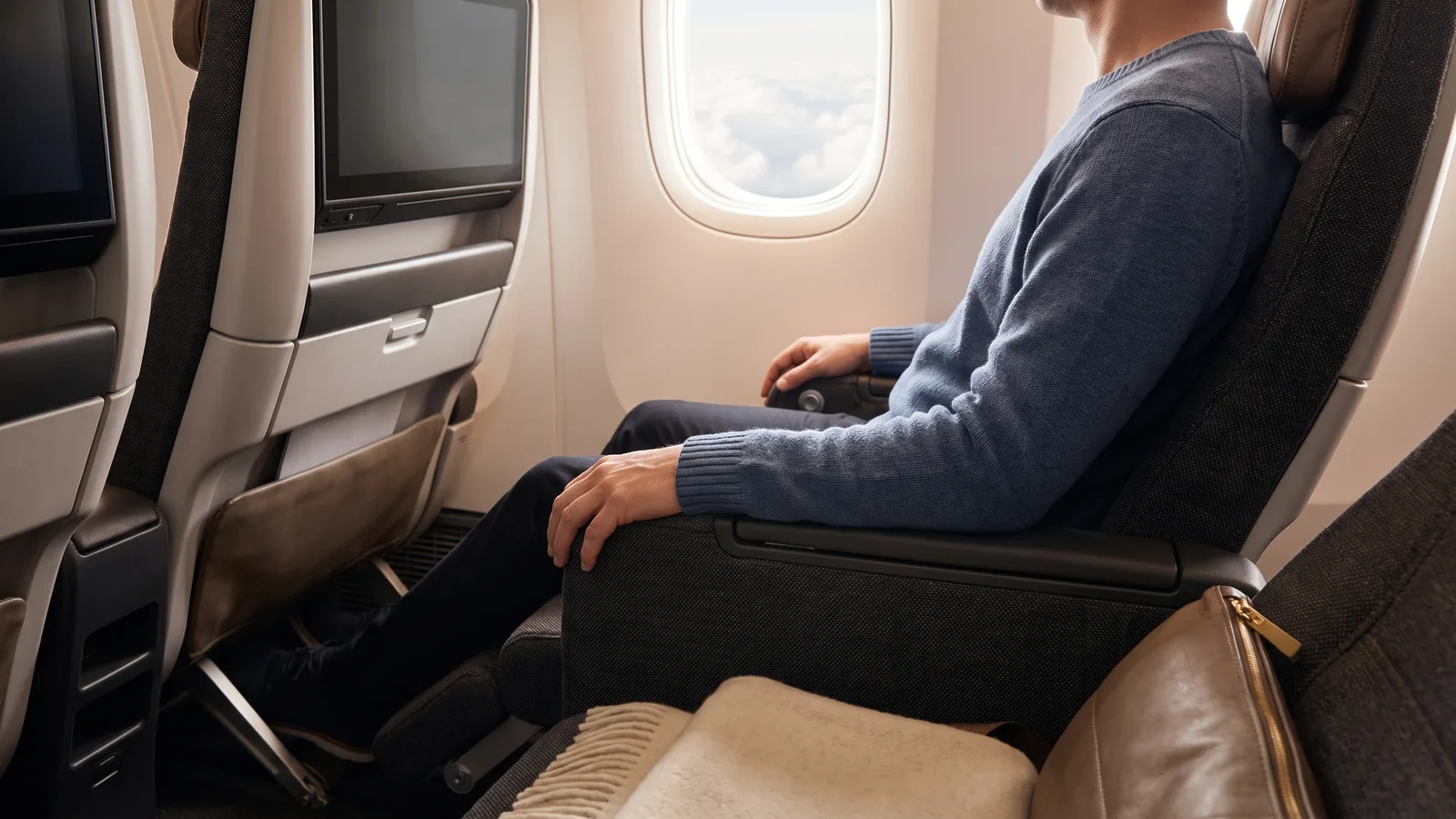 Illustrative image, AI-generated
At a glance#
| Feature | Economy | Premium economy | Business |
|---|---|---|---|
| Pitch | tight | noticeably more | a bed |
| Width | narrow | somewhat wider | much wider |
| Recline | slight | deeper | flat |
| Catering | standard | improved | multi-course |
| Lounge | no | usually no | almost always |
| Price against economy | base | about double | three to ten times |
Premium economy is the youngest of the three long-haul cabins, and the name on its own says little about what waits behind the curtain.
What the cabin adds#
Premium economy delivers three things: more distance to the row in front, a little more width, and a seat back that reclines further. On a long sector that is not a small difference, because all three act on fatigue at the same time.
Extras come on top and vary by airline: a footrest, a larger screen, improved catering, an extra bag and in some cases priority handling at the airport. None of those belongs to a definition, all of them are individual decisions.
What premium economy does not give matters just as much: no flat bed, in general no lounge access and no business-level catering. Buying the cabin as half a business class means buying against the wrong expectation. What the name business class covers is set out in business class.
Two products under one name#
The real cabin#
On modern long-haul aircraft premium economy is a separate cabin with its own seats. The seats are different seats, not the same ones with more space. The giveaway is width and the fact that the row holds fewer places, seven instead of nine for example. This build is the product that earned the cabin its reputation.
The economy variant with extra pitch#
Older aircraft and some airlines sell economy seats with extra distance to the row in front under the same or a similar name. Width stays the same, recline stays the same, only legroom grows. The gap to the real cabin is substantial, and the price frequently sits in the same range anyway. Which variant is on board follows from the aircraft type and the seat map, as finding your aircraft shows.
How to tell the real cabin apart#
Three markers separate the two reliably, and all three are known before booking.
The clearest is the number of seats per row. Where it drops against the economy cabin of the same aircraft, from nine to seven for instance, the seats are purpose-built. Where it stays the same, the product is an economy seat with more pitch.
The seat width in centimetres, which many airlines and seat maps publish, confirms it. A difference of two to four centimetres against economy points to the real cabin.
The position in the aircraft settles any remaining doubt. A real cabin has its own bulkhead and its own galleys, a partitioned block inside economy has neither, and the seat map shows which is which.
Why the cabin exists at all#
Premium economy is not an answer to a passenger wish but to an airline problem. Between a 700 euro economy ticket and a 2,900 euro business ticket sits a gap holding a large number of travellers: people who would pay more, but not four times more.
Filling that gap pays twice over. A premium seat yields more revenue per square metre of cabin than an economy seat, and it costs less weight and less onboard service than a business seat. From the airline’s side the cabin is therefore the highest-earning floor space in the aircraft.
The cabin is unlikely to disappear, but it is being subdivided further. Several airlines already run two fare tiers inside premium economy, one with and one without changes, seat selection and full mileage accrual. The name above the cabin therefore says less every year and the fare says more.
Worked example: a 400 euro premium over ten hours#
A long-haul flight costs 720 euros in economy and 1,120 euros in premium economy. The premium is 400 euros for ten hours out and ten hours back, so 20 euros an hour.
Two items can be priced: the extra bag at 60 euros and, with airlines offering priority handling, perhaps 20 minutes saved in each direction. That leaves roughly 340 euros for space and recline across 20 hours in the air.
The same flight in business costs 2,900 euros. The step from economy to premium costs 400 euros, the step from premium to business a further 1,780. Put differently: the first half of the comfort is cheap and the second half expensive. That is the economic core of the cabin, and it explains why it prices better than business class on day flights.
Two travellers double the premium. Eight hundred euros for a couple on one trip is an amount that funds several nights in a better hotel at the destination. That comparison belongs in the calculation, because it sets the benefit against a real alternative rather than against nothing.
The extras in detail#
Lounge access is the most frequently misexpected item. A handful of airlines grant it, most do not. Anyone who needs it enters through a tier or a membership, as described in lounge access, rather than through the ticket.
The baggage allowance is usually raised but sits in the fare rather than in the cabin. At cheap premium fares with some airlines it matches economy.
Status credit sits between economy and business, sometimes much closer to economy. The letter of the fare class decides, and this cabin holds several classes with different accrual.
Priority handling at the airport is included by some airlines and then covers a dedicated desk and occasionally faster security. It is the extra with the widest spread between providers, and at a busy airport in the morning it does more than another few centimetres of legroom.
Seat selection is frequently free in premium economy, though not everywhere. The front row sometimes still carries a charge.
Why the cabin is so small#
Premium economy holds between twenty and fifty seats on most aircraft. Two practical consequences follow from that size.
The first concerns availability. Award seats in this cabin are scarce because the cabin is scarce, and they disappear faster than in economy. How that inventory is released is covered in disappearing award space.
The second concerns downgrades. When a flight is oversold or the aircraft is swapped, small cabins are hit first. A downgrade from premium economy to economy is markedly more common than one out of business class, and the claim to the difference in fare exists in both cases.
The route through an upgrade or a bid#
Many airlines sell the move out of economy after the fact, either at a fixed price or through a bid. Both routes are cheaper than buying the cabin outright, and both are non-binding until confirmed.
The fixed price is frequently offered at check-in and often sits at a third to a half of the price gap between the cabins. That calculation almost always holds, provided the cabin is the real one.
A bidding process asks for an amount before departure. The benchmark for a bid is today’s cash price of the cabin minus the economy fare already paid, not the saving the page advertises. A bid succeeds only where the cabin is not sold out, and acceptance often comes a few days before departure.
Two side effects deserve attention. Status credit after a paid upgrade usually still follows the original economy fare. And during a disruption the original fare governs, with any refund of the upgrade amount handled as a separate matter.
When it is not worth paying#
On overnight flights before a working day the cabin is a compromise that misses both targets. Anyone who has to sleep needs a flat surface, and this cabin has none. The premium then buys a slightly more comfortable sleepless night.
Below six hours the benefit is small. The gain in pitch works through time, and on a short sector an exit row in economy is the better calculation, as exit row seats shows.
Where only legroom is missing, it is available more cheaply. A paid seat with extra pitch costs a fraction, and how to judge that charge sits in seat selection fees.
Travellers with children measure against a different alternative: four seats together in economy are often more practical than four scattered seats in a small premium cabin, and the price difference covers a series of extra costs at the destination.
And where the cabin is in truth the economy variant with extra pitch, the price of the real cabin buys a substantially smaller product. Checking that before booking is the most important step in the whole subject, followed by the question of whether the flight is a day or a night sector. Both answers are available before the purchase.
Who benefits most#
Three groups draw the largest benefit, and they differ less in budget than in the kind of travel they do.
The first are travellers on day flights. Ten hours upright is considerably more bearable with more space, and the main advantage of business class, the flat bed, goes unused in daylight anyway. For this group premium economy is not the compromise but the right product.
The second are tall travellers. The gain in legroom works disproportionately for them, because economy pitch is not tight but unusable at a certain height. The measurement behind that sits in seat pitch.
The third are travellers with baggage. Where the cabin includes an extra piece, that item alone covers a noticeable share of the premium, and it credits twice on a return trip.
None of those groups is defined by travel budget, which is the difference from business class, almost always a budget decision. What unites them is that the gain they want is space. Premium economy offers the best ratio of premium to gain as long as that holds, and becomes the worst choice as soon as the gain is supposed to be sleep, because the cabin was not built for it.
The most common mistakes#
- Reading the cabin as half a business class. It delivers space, and sleep is not part of the deal.
- Expecting lounge access. Most airlines leave it out.
- Booking without the seat map. The map shows whether the cabin is purpose-built or a block of economy seats with more pitch.
- Relying on it for an overnight flight. For sleep the choice is business or economy, depending on the budget.
- Deriving the baggage allowance from the cabin. The allowance sits in the fare, and cheap premium fares sometimes match economy.
- Costing the premium for one person only. With two travellers it doubles.
Related topics#
Frequently asked questions
How much more space is there?
Does lounge access come with it?
Do I get more baggage?
Does it earn more status credit?
Can I book it with points?
Can I upgrade from economy?
What about the catering?
Is it on every long-haul route?
How does it differ from an economy seat with extra legroom?
Is it worth it on day flights?
Does it get oversold like economy?
Sources
Which flights are really in your spending?
In a free strategy call, we translate your spending into your actual routes and travel dates. Want to see the number first? The calculator shows it in about 30 seconds.
30 minutes · online · no obligation
What we'll cover in the call
- Which airline programs fit our routes?
- How many flights are realistic for our spending?
- What do taxes and fees cost on award flights?