
Is an exit row seat worth paying for?
Why the row has more legroom, which duties come with it, who may not sit there, why some of these seats are less comfortable than expected and when the fee is not worth paying.

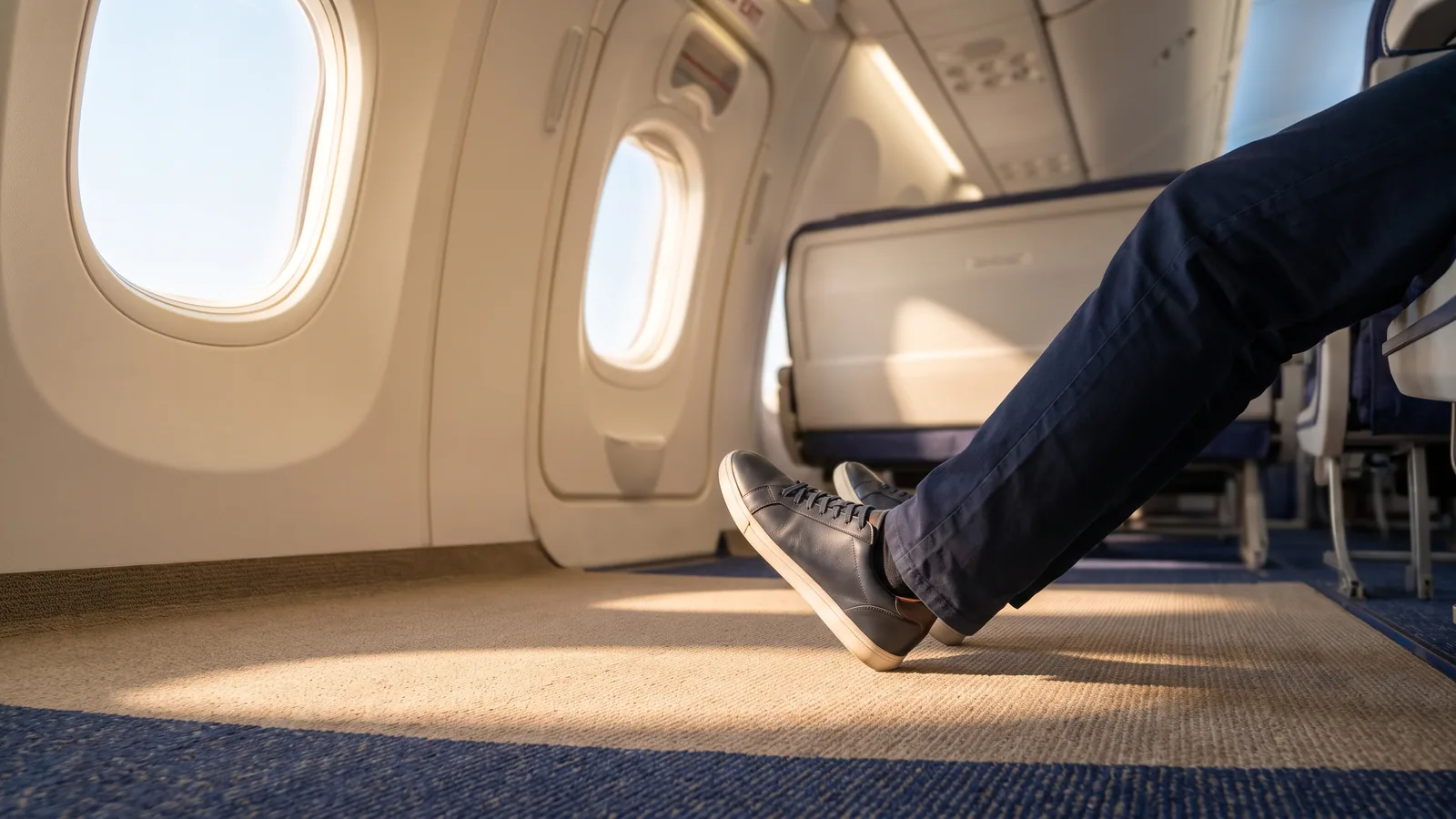 Illustrative image, AI-generated
At a glance#
| Feature | Exit row |
|---|---|
| Legroom | substantially greater |
| Recline | frequently fixed |
| Bag at the seat | prohibited |
| Duty to assist | yes, in an emergency |
| Exclusions | children, companions, mobility, language |
| Price | usually the highest on the map |
Why there is more space#
The exit row gets passed around as a tip far more often than its conditions get named. Its extra room is a safety requirement, not a concession to tall people. The path from the aisle to the door must meet a minimum width so that an evacuation can be completed inside a prescribed time. That width is created by moving the row further back.
Everything else follows from that origin. The space belongs to safety, not to the passenger, which is why the rules are stricter here than anywhere else in the aircraft. During take-off and landing the area must be completely clear, meaning no bag, coat or blanket, and the crew checks.
Who may sit there follows from the same logic. A passenger in that row is part of the procedure in an emergency, so suitability decides the allocation, and the price comes second.
Why the duties are this strict#
The measure behind all of it is a single number from certification: an aircraft must be fully evacuated within a short prescribed time, using half of the available exits. That is demonstrated under supervision before the type enters service.
The whole chain of rules follows from that figure. The path must be clear or the time fails. The door must open in seconds or the time fails. And whoever opens it must be able to, or the time fails.
No framing in the subject helps passengers more. The conditions are not an inconvenience and not a price for the space; they are the reason the space exists. Treating them as a fee for legroom leads to arguing on board and losing.
The same logic explains why crew decide against the passenger in case of doubt. A wrong decision in that direction costs an annoyed traveller; a wrong decision the other way costs time nobody has in an emergency.
What the duty involves#
Before every departure a crew member addresses the row and asks for an explicit confirmation, and the answer is the basis of the allocation, far more than a formality.
Three things are expected. Opening the door or window exit in an emergency, which depending on the aircraft means force and a two-figure weight. Moving the removed element out of the way or throwing it clear. And assisting other passengers out while following crew instructions.
The exclusions follow from those three and are broadly identical internationally. Children and anybody accompanying a child are excluded. Travellers with reduced mobility, with a visual or hearing impairment, and with an animal on board are excluded. And anybody who cannot understand crew instructions is excluded.
The last point is the most underestimated. What is required is not politeness but communication under noise and stress, and the crew decides after a short exchange. A passenger who is addressed and does not answer gets moved.
What happens during the pre-departure check#
The routine is similar everywhere, takes half a minute, and decides whether the seat is kept.
A crew member steps to the row, states the duties briefly and asks whether everybody is willing and able to help in an emergency. A nod is not enough; an audible answer is expected, because the answer is also the evidence that the language was understood.
The check fails surprisingly often on small things. Passengers who are asleep, wearing headphones or deep in conversation are addressed and moved if in doubt. Passengers visibly under the influence are moved as well. Neither is a matter of interpretation; both are routine.
Where a move happens, the seat is gone and the fee must be refunded, because a paid service was not delivered. The claim exists even where the reason lay with the passenger, since the airline should not have sold the seat in the first place. Arguing on board is still pointless, because a crew decision in flight is not reviewable.
Why some of these seats disappoint#
The row in front of the exit#
Where two rows sit one behind the other at the same pair of exits, only the rear one carries the full benefit. The front row may not recline, because doing so would block the path. Its pitch is normal, its usability worse than an ordinary seat, and it is still occasionally sold as extra legroom.
The seat beside the door#
At a door set into the fuselage the wall steps inward. The seat next to it loses width at shoulder height, and the armrest is sometimes fixed. On long flights a second point arrives: the draught at the door seal is noticeable, and a blanket is not permitted during take-off and landing.
The screen in the armrest#
Because there is no seat in front, the screen is built into the armrest and only deploys in cruise. The armrest becomes thicker, the seat narrower, and on some aircraft the loss runs to several centimetres. Which variant is on board is shown by the seat map, as finding your aircraft describes.
Worked example: exit row against premium economy#
On a ten-hour flight the exit row costs 65 euros each way. Premium economy costs 400 euros extra each way on the same route.
For 130 euros return, economy delivers the largest pitch the aircraft offers, frequently more than premium economy has. What is missing is the width, the deeper recline, the better catering and the extra bag, and the price difference between the two is 670 euros.
A traveller who mainly needs legroom, because of height, gets it in the exit row for a fraction. A traveller who wants to sleep does not get it there, because the seat back is often fixed. The two products solve different problems, and the choice depends on which problem you have. The cabin comparison sits in premium economy.
How the row gets allocated#
Three routes lead to a seat there, and they differ in price and certainty.
The first is buying at booking. Expensive and certain, provided no aircraft swap intervenes. Judging that fee sits in seat selection fees.
The second is status. Many programmes give members access to these rows at no charge, in some cases from the first tier. For frequent flyers it is one of the few benefits that pays on every single flight.
The third is release at check-in. Unsold seats are released free of charge when check-in opens with many airlines, because the crew has to fill them anyway. Checking in promptly sometimes gets them for nothing.
Swapping on board is not a route at all here, because the crew must approve every move and re-checks suitability.
What else comes with the row#
Four side effects only become apparent on board, and all four belong in the decision.
The first is noise. Exits over the wing sit level with the engines, and the level there is higher than further forward. On a long flight that partly offsets the legroom gained.
The second is through traffic. The row sits at a natural narrow point, and passengers gather there while waiting for the lavatory. An aisle seat gets brushed past more often than elsewhere.
The third is life without a bag at your feet. The advantage of clear floor space reverses if you have to reach the overhead bin all flight for a book, a bottle or headphones. Deciding in advance what you need, and putting it in the seat pocket, solves it.
The fourth is the cold at the door. On long flights the area at the door seal is noticeably cooler, and a blanket is not permitted during take-off and landing.
When it is not worth paying the fee#
Several situations argue against it.
Below three hours the gain is small and the restrictions weigh more than the space, so the fee is rarely worth it. A coat that may not sit on your lap and a backpack that has to go overhead is a poor trade for an hour.
On overnight flights the fixed recline is the decisive drawback. Anybody who wants to sleep does better in an ordinary row, and the reasoning sits in seat pitch.
Travelling as a pair or a family, the row is frequently unsuitable, because seats are sold individually and children are excluded.
And where the row is the front one of two, it is not a gain but a loss with a fee attached. Checking that on the seat map is the single most important step before buying.
Which aircraft have which rows#
Exit positions depend on the aircraft, and three recurring pictures follow.
Narrowbodies usually have one pair of overwing exits, sometimes two pairs in sequence. In the second case the front row is the one with the fixed recline, and that pair is the most common misbooking in the whole subject.
Widebodies have several doors along the length, and the rows behind them vary in space. At some doors a bulkhead sits in front of the row in place of an open path, which gives legroom but no space for feet under a seat in front.
Regional aircraft frequently have a single usable exit at mid-cabin, and the row beside it is the only seat with extra room in the whole aircraft. It goes quickly.
Which layout applies is shown by the seat map, and it differs between two variants of the same model. The row number that was right on the last flight can be the wrong one this time.
For legroom, the exit row is the best value in all of economy; for sleep, it is not. The price is real duties and a clear floor during take-off and landing. Two checks before buying decide nearly everything: whether this is the rear of the two rows, and whether you meet the conditions. Both answers are available before booking, and both cost one look at the seat map of the specific flight.
The most common mistakes#
- Taking the front row for the roomy one. Only the rear row carries the full benefit.
- Relying on it for an overnight flight. A fixed recline costs the sleep.
- Expecting to keep a bag at your feet. Everything goes away for take-off and landing.
- Ignoring the conditions. The crew will move you, and the fee then has to come back.
- Booking it while travelling with children. Accompanying adults are excluded along with the children.
- Skipping the check after an aircraft swap. On another model the row sits elsewhere.
- Putting everything in the overhead bin. What you need in flight belongs in the seat pocket, decided before take-off.
Related topics#
Frequently asked questions
Why is there more space there?
What duties do I take on?
Who may not sit there?
Do I have to speak a particular language?
May I keep a bag at my feet?
Does the seat recline?
Is the row always chargeable?
Can I be moved at the gate?
Is it colder there?
Are all exit rows the same?
Does it suit families?
How do I spot it on the seat map?
Sources
Which flights are really in your spending?
In a free strategy call, we translate your spending into your actual routes and travel dates. Want to see the number first? The calculator shows it in about 30 seconds.
30 minutes · online · no obligation
What we'll cover in the call
- Which airline programs fit our routes?
- How many flights are realistic for our spending?
- What do taxes and fees cost on award flights?