
What is seat pitch on a plane?
What seat pitch measures and what it does not, why width and recline count just as much, how to find the figure before booking, which rows differ and when paying for space is wasted.

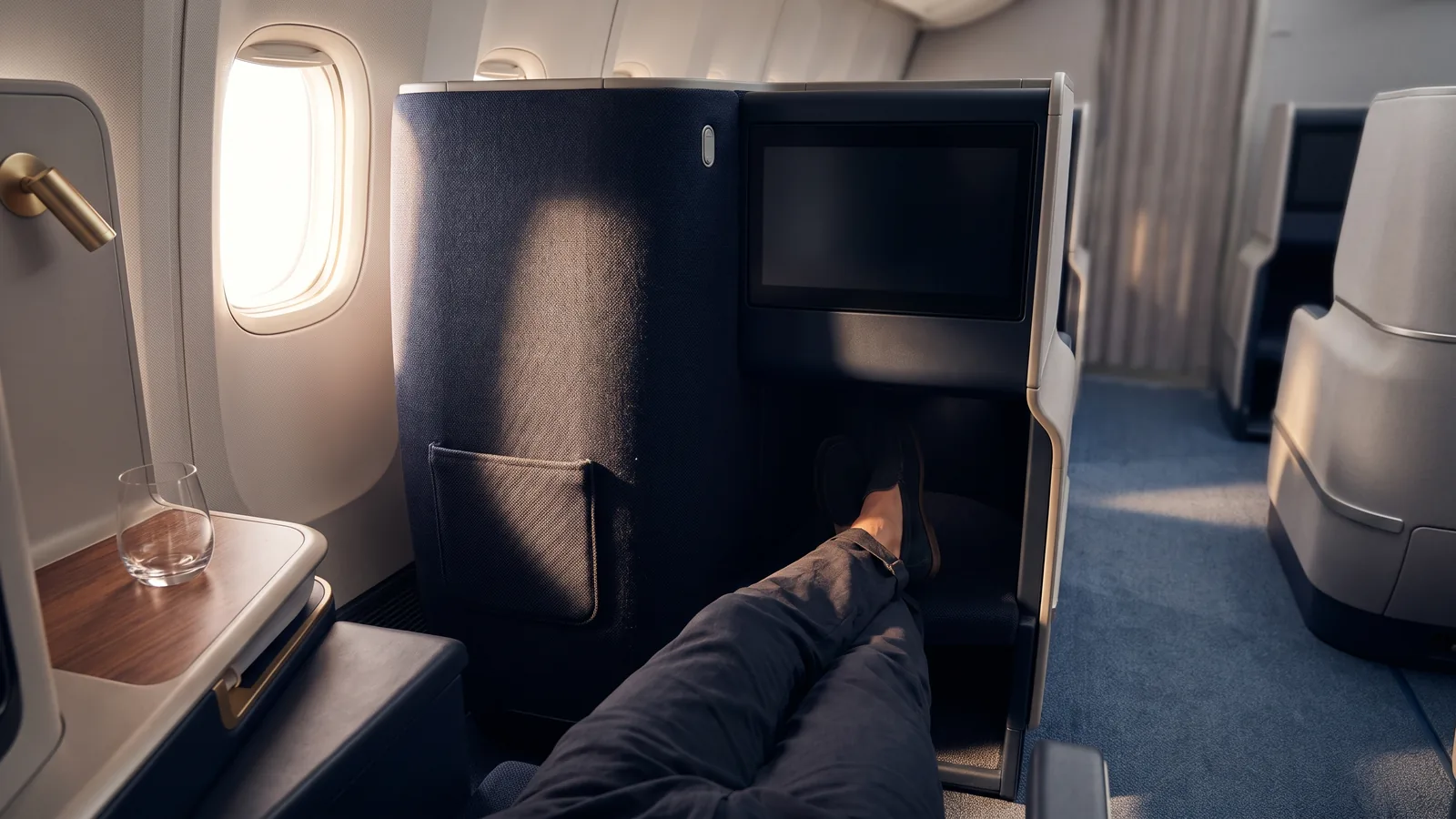 Illustrative image, AI-generated
At a glance#
| Cabin or row | typical pitch | note |
|---|---|---|
| Economy short haul | 28 to 30 in | often a fixed seat back |
| Economy long haul | 30 to 31 in | the standard case |
| Economy with a fee | 32 to 34 in | paid extra |
| Exit row | 35 to 40 in | conditions, no bag at the seat |
| Premium economy | 38 to 41 in | wider seat, deeper recline |
| Last row | same as standard | seat back often fixed |
Seat pitch is the most quoted number in the cabin and the one most often misread. It measures something real, just not the thing most travellers assume.
What the number measures#
Seat pitch is a distance between two rows, taken from a fixed point on one seat to the same point on the seat in front. Measurement is usually at the seat back or at the seat track. It is normally quoted in inches, one inch being 2.54 centimetres.
What matters is what is not measured: the free space in front of your knees. Between the two measurement points sits the whole seat in front, meaning the back, the padding, the pocket and the screen. When the seat back gets thinner the free space grows without the number changing.
The most common confusion in the subject follows from that. Two aircraft with identical pitch can differ by several centimetres of usable space. A modern slim shell at 30 inches leaves more room in front of the knee than an older seat at 31.
Why the number is still useful#
Despite the imprecision, pitch is the only figure airlines publish with any consistency and the only one that compares between aircraft. Inside one fleet and one seat generation the comparison holds; between two airlines with different seats it is approximate at best.
A second figure belongs beside it: seat width. It follows from the number of seats per row and the width of the fuselage. Nine seats across in a cabin designed for eight costs each passenger roughly two centimetres of width, and those two centimetres matter more on a ten-hour flight than three centimetres of pitch.
The third figure is recline. It decides whether a seat is usable for sleeping, and it is missing from almost every comparison. Which cabins make it relevant at all is covered in business class. Judging a cabin properly takes all three figures, pitch, width and recline, plus the aircraft type they belong to.
How to find the figure before booking#
The route through the aircraft type#
Seat pitch attaches to the aircraft, not to the route and not to the price. The first step is therefore always to establish which type operates the specific flight, as described in finding your aircraft. Only with the type and the airline can a seat map be looked up.
Why the same flight can be configured differently#
Airlines frequently operate one aircraft type in several cabin configurations, after taking over another carrier or after refitting part of a fleet. The booking page often shows only the type and not the variant. The answer becomes reliable at seat selection, because the map shown then belongs to the aircraft scheduled for the flight. An equipment swap shortly before departure can still change it.
Which sources hold up#
Three sources publish pitch, and they differ in reliability.
The airline’s own figure is usually correct but rounded and often given as a range. It applies to the fleet, not to the individual aircraft.
Third-party seat map services are more precise because they distinguish variants, but they depend on reports and can go stale. After a cabin refit they are sometimes wrong for months.
Seat selection inside the booking flow is the most dependable source because it attaches to the specific aircraft, but it rarely states a number. It shows the layout, and the deviating rows can be read from it.
Working carefully means combining all three: the airline range as a frame, the seat map service for the variant, seat selection for the row.
Worked example: two inches for 45 euros#
On a nine-hour flight the airline offers seats with two inches of extra pitch for 45 euros each way. The standard figure is 30 inches, the paid one 32.
The 90 euros for the return spread across 18 hours in the air, so five euros an hour. The gain is roughly seven per cent of pitch. For a traveller of 175 centimetres that is a convenience, for one of 195 centimetres it is the difference between bearable and not.
The same 90 euros is about an eighth of the premium that premium economy costs on the same route, and that cabin would add eight inches of pitch, more width, a deeper recline and an extra bag. Faced with that choice, the two offers belong side by side, not one after the other. Judging the fee itself is covered in seat selection fees.
Short haul and long haul follow different rules#
On European and domestic short-haul routes pitch frequently sits below long-haul values, and that has to do with duration. An hour in the seat demands less room than ten, and airlines configure their fleets accordingly. Values around 29 inches are widespread, with some carriers below that.
Two side effects stand out. Short-haul seats are often non-reclining, which makes nearly all of the measured pitch usable and shrinks the practical gap to long haul. And long-haul aircraft are occasionally deployed on short routes, which suddenly puts 31 inches under a one-hour flight.
A regular on the same short route can exploit that by sorting connections by aircraft type instead of departure time. The effort pays for frequent flyers and for nobody else.
The rows that break the rule#
A seat map is never uniform. Five deviations occur almost everywhere.
The exit row has the largest pitch but demands assistance in an emergency, allows no bag at the seat and occasionally has a fixed seat back. The conditions in detail sit in exit row seats.
The bulkhead row has plenty of legroom but no space under the seat in front and often a fixed screen in the armrest, which narrows the seat.
The row in front of an exit frequently has a fixed seat back so the path stays clear. Measured pitch is normal, usability is not.
The last row has the same pitch as the rest but often a wall behind it and therefore no recline.
And the rows over the wing have identical pitch with less noise towards the front and more towards the rear, which has nothing to do with pitch but falls into the same decision.
The number across the cabins#
The step between cabins is unevenly distributed, and that unevenness explains the pricing better than any description.
From economy to a paid economy row with extra pitch the figure grows by about seven per cent, and the price rises by a small two-figure amount. From there to premium economy it grows by a further twenty to thirty per cent and the price doubles. And from premium economy to business the measurement stops mattering, because the seat becomes a bed and a distance between rows no longer describes it.
A usable rule of thumb follows: inside economy, space is cheap to buy, the step into the next cabin is expensive, and the step after that is a different category of spending. Anyone looking only for space stays on the first rung.
Why the values have fallen#
Measured pitch has shrunk across many fleets over recent decades, for two reasons that work against each other.
The first is commercial. Every additional row delivers six to ten seats on a long-haul aircraft, and across a fleet that is a substantial number. While those seats sell, an airline has little reason to forgo them.
The second is technical and pulls the other way. Seat shells have become thinner, pockets have moved upwards, screens are flatter. Usable space has therefore fallen less than the measured figure. Both movements together explain why decade-long comparisons look more dramatic on paper than the difference feels on board.
What else matters besides the number#
Three factors change the experience more than three centimetres of pitch, and none appears on a seat map.
The neighbour comes first. An empty middle seat transforms a tight row, and it is the very thing European business class sells as its main benefit.
Time spent seated is not the same as flight time. An aisle seat allows standing up without disturbing anyone, a window seat does not. On an overnight flight with sleeping neighbours, a window seat at 32 inches is less comfortable than an aisle seat at 30.
Then there is the bag at your feet. A bag under the seat in front takes up the very space that counts as legroom. Putting it in the overhead bin gains more than any fee buys, and what may go into the cabin is covered in carry-on rules.
When it is not worth paying for space#
A rough rule covers most travellers. Below three hours the number is irrelevant, above eight hours it decides how you feel on arrival, and in between it depends on your height.
On short flights the difference is small and the expense hard to justify. An hour in a tight seat is unpleasant but has no consequences.
At a shorter height the premium buys little. A traveller of 165 centimetres has no contact with the row in front at 30 inches, and two more inches change nothing.
Where the real strain is width, pitch does not help. A narrow seat stays narrow however far away the row in front is, and the answer then is premium economy or an aircraft with a different configuration.
Travelling as a pair sometimes reverses the calculation. Two seats in a pair by the window, where they exist, beat two paid seats with extra pitch in a row of three with a stranger, and they cost nothing.
And where the choice is between a fee and checking in earlier, checking in is often cheaper. Free seats with more room are released at no charge when check-in opens with many airlines.
The most common mistakes#
- Treating pitch as legroom. The seat back in front sits inside the measurement, and its thickness decides how much of the number reaches your knees.
- Comparing two airlines on the number. The figure only compares cleanly inside one seat generation.
- Ignoring width. The number of seats per row says more about a long flight than an inch of pitch.
- Searching by route instead of aircraft. The aircraft type decides, not the destination.
- Booking an exit row unchecked. The conditions and the recline deserve a look before paying.
- Paying for two inches without pricing premium economy. Side by side, the two offers often look very different.
- Keeping the bag under the seat in front. The overhead bin is the cheapest legroom there is.
Related topics#
Frequently asked questions
What exactly does seat pitch measure?
Why do identical figures feel different?
What is normal in economy?
At what height does it start to matter?
Does seat width count as much?
Where do I find the figure before booking?
Why does the figure change on the same route?
Which rows differ?
Does an aisle seat help?
Is more pitch always better?
Has pitch shrunk over time?
Which flights are really in your spending?
In a free strategy call, we translate your spending into your actual routes and travel dates. Want to see the number first? The calculator shows it in about 30 seconds.
30 minutes · online · no obligation
What we'll cover in the call
- Which airline programs fit our routes?
- How many flights are realistic for our spending?
- What do taxes and fees cost on award flights?