
What do I actually get in business class?
Why business class means something different on short and long routes, which ground services belong to it, how seat layouts differ, how to judge the premium and when it buys nothing.

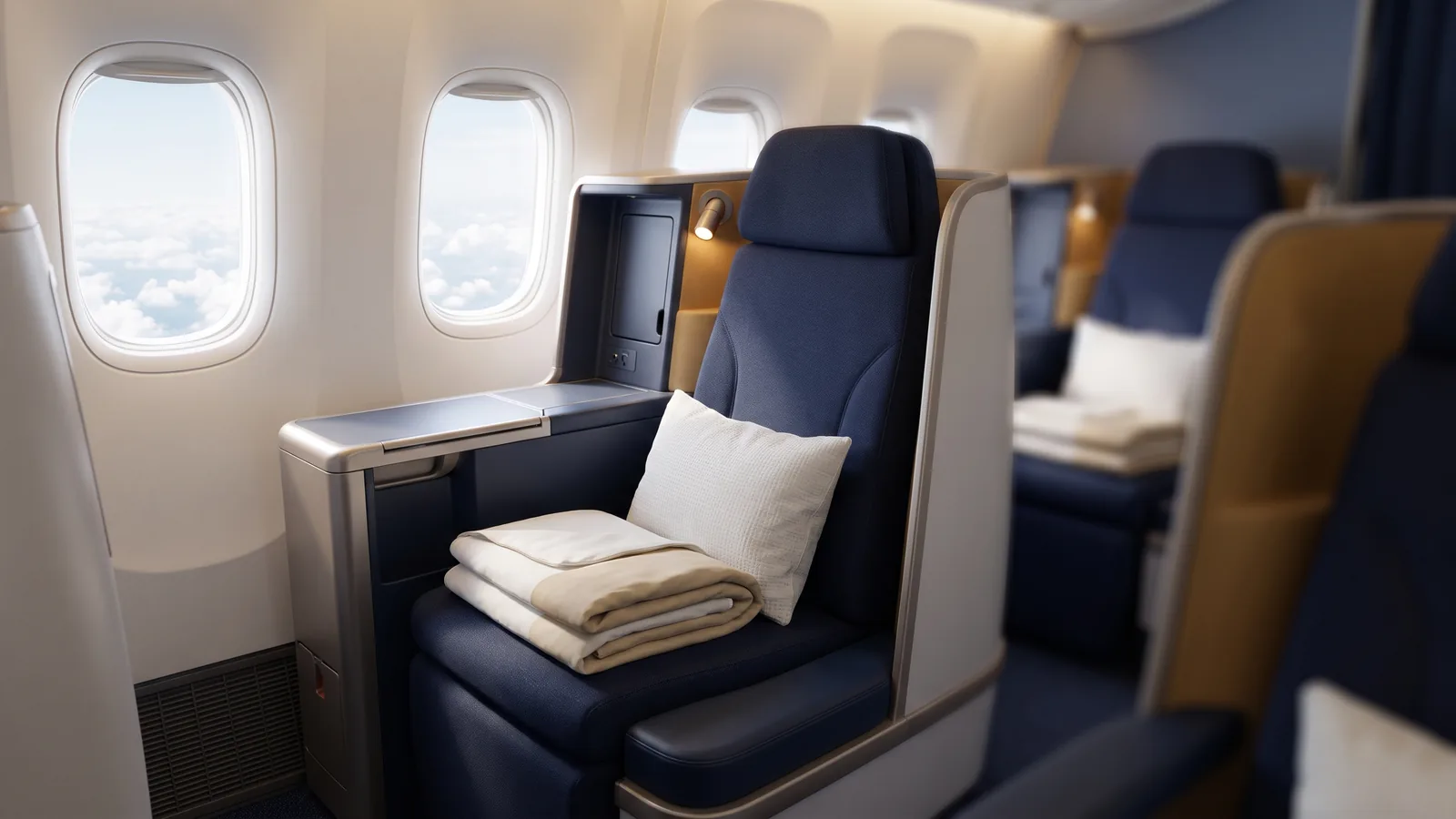 Illustrative image, AI-generated
At a glance#
| Feature | Short haul in Europe | Long haul |
|---|---|---|
| Seat | economy seat, adjacent place blocked | flat bed, usually aisle access |
| Catering | hot meal at the seat | multi-course menu, drinks selection |
| Lounge | depends on the airline | almost always |
| Checked baggage | one or two pieces | two pieces, higher weight |
| Ground handling | own desk, priority | own desk, often a separate area |
| Price against economy | two to three times | three to ten times |
Business class is the most familiar word on a boarding pass and one of the least precise. Reviews describe one airline’s seat on one route; the term itself names a fare in a sales system, and what that fare buys changes from flight to flight.
Why the name guarantees nothing#
Business class is not a standard. No authority defines what a cabin must contain to carry the name. The term describes a price class in the sales system, and what sits inside it is decided by each airline for each route and each aircraft type separately.
Freedom of that kind is the single largest source of disappointment in air travel. Two tickets carrying the same word on the boarding pass can mean a flat bed on an overnight sector or an ordinary seat with an empty place next to it on an hour inside Europe. Both are correctly sold as business class.
What matters is the cabin of the specific aircraft on the specific flight, whatever the name on the ticket. How to establish the aircraft type before booking is covered in finding your aircraft. That check is the only reliable way to know what is being bought.
The three long-haul layouts#
Seats without direct aisle access#
Older cabins place seats in pairs, often two either side and two or three in the middle. A window seat is then reachable only if the neighbour stands up or is climbed over. On an overnight flight that difference is substantial, because it decides whether getting up requires disturbing somebody.
Seats with aisle access for everyone#
More recent cabins stagger the seats so every place touches an aisle, commonly four seats per row in a widebody. The space per passenger is not necessarily larger, but the independence is complete, and in daily use that is the sharpest difference between the two layouts.
Seats with a door#
The newest layout adds a door or a high divider. The gain is smaller acoustically than expected and larger visually. For travellers who value privacy it is the most noticeable advance of recent years; for travellers who mainly want to sleep, the length of the bed still matters more than the door.
What short haul inside Europe is#
Inside Europe the cabin has its own history, and it explains the most common disappointment in the subject. The cabin is the same as the back of the aircraft, the same seats, the same row spacing. It is separated by a movable curtain and by the rule that the middle place of each row of three stays empty.
What is sold is therefore three things: space beside the seat, catering, and the services on the ground. The seat itself is not a benefit, and expecting one means misreading the product.
The construction has an operating reason. A European short-haul fleet flies business routes and leisure routes on the same day, and a fixed second cabin would sit empty on half of those flights. The curtain is the answer: it moves forward or back by a row or two according to demand.
One practical consequence concerns seat selection. The front row in these cabins frequently has less legroom than an exit row further back, and the exit row costs a fraction of the premium in economy. Anyone looking only for space finds it more cheaply in exit row seats.
Long-haul aircraft deployed on European routes are the exception. They carry their long-haul cabin with them, which occasionally means a flat bed for the price of a European business fare. Finding such flights is a question of aircraft type, and the fare gives no hint.
What comes with it on the ground#
The cabin is only part of the product. Four ground services usually belong to it, and each has its own limits.
The dedicated check-in desk saves time at busy airports and nothing at quiet ones. Priority security is at many airports the most noticeable benefit of all, yet it does not exist everywhere. Lounge access is nearly always included long haul and inconsistent short haul; the other routes into a lounge are covered in lounge access. And priority baggage delivery is the least dependable of the four, because it rests with the ground handler at the destination, not with the airline.
A fifth benefit is rarely advertised and matters most when things go wrong: priority in rebooking. When a flight is cancelled, airlines work the waiting list by cabin and status, not in order of arrival. A passenger from the front cabin is rebooked first, and during an evening disruption that decides between a flight the same day and a night at the airport. The benefit appears in no brochure because it exists only in a situation nobody wants to advertise.
The higher baggage allowance comes on top. It attaches to the fare and not to the cabin, which produces surprises on the cheapest business fares.
Worked example: premium against value on an overnight flight#
A long-haul flight costs 680 euros in economy and 2,400 euros in business. The premium is 1,720 euros for one night in the air and a daytime return.
The value consists of four items: the night in a flat bed, the lounge, the extra bag and the higher status credit. A hotel room at the destination costs 160 euros, a second bag 60 euros, lounge access on a day pass 40 euros. Together that is 260 euros of spending replaced. The remaining 1,460 euros is the price of sleep and comfort.
On a day flight the largest item disappears entirely, because nobody sleeps in daylight. The same premium then buys eight hours of extra legroom, and the comparison with premium economy almost always favours the cheaper cabin. Business class is a night product, and its valuation flips with the time of day.
The fare decides as well#
Price tiers exist inside business class, and they differ in more than price. Cheap fares in the class are frequently non-changeable, non-refundable and credit fewer status miles. Some airlines exclude seat selection or lounge access at these fares.
Which fare was booked sits in the letter of the fare class, and the cabin name does not show it. Two passengers side by side in the same cabin can therefore hold completely different rights while seeing the same word on their boarding passes. Anyone wanting to know what their own ticket permits reads the fare rules.
A price comparison between two business offers is only a comparison once the fare rules sit beside it. A gap of 200 euros can be explained entirely by changeability.
The route through points#
For many programmes long-haul business is the most valuable redemption available, and the reason lies in the price structure. The cash price of the cabin is a multiple of the economy price, while the award price rarely exceeds double. Value per point therefore jumps as soon as the redemption moves from the back cabin to the front.
The limit is availability, seldom the points balance. Airlines release only part of the cabin for awards, and that part goes quickly on popular routes at popular times. How the release works, and why a seat vanishes that the search showed a moment ago, is covered in disappearing award space.
Two practical points belong with it. Award bookings in business class almost always carry taxes and surcharges, and with some airlines those reach the order of an economy ticket. And award flights earn no status credit, so they do not count towards qualification.
When it is not worth paying#
Several situations argue clearly against the premium.
On short routes inside Europe the product is in many cases an empty adjacent seat and a hot meal. Below two hours the premium is hard to justify unless the lounge and the ground handling decide it.
On day flights the main benefit is missing. Departing in the morning and arriving in the evening means paying for a seat built as a bed and used as a chair.
On very short long-haul sectors, four or five hours in the morning, the case sits in between. The cabin is the large one, the seat is a bed, and it gets used as an armchair. Paying here means paying for the ground handling and the quiet, not for sleep.
With a tight connection the cabin changes little, because the real uncertainty lies elsewhere. A short connection is a problem of the itinerary, and no cabin solves it, as connection time shows.
And where the premium comes out of the traveller’s own pocket and the alternative would be an extra trip, the arithmetic changes shape. Two economy trips a year are worth more to many people than one in business.
How to compare two offers#
A sound comparison of two business offers needs five pieces of information, and four of them are not in the price.
The first is the aircraft type for each sector. A connecting itinerary can have a European cabin on the first leg and a long-haul cabin on the second, and the fare says nothing about it.
The second is the seat layout. Four seats a row with aisle access and six seats a row without are two different products under one name.
The third is the time of day. An overnight sector uses the flat bed, a daytime sector does not.
The fourth is the fare with its conditions: changeability, mileage accrual, seat selection.
The fifth is the price. It belongs at the end of the list, because without the other four it carries no information.
Laid side by side, those five regularly show that the more expensive offer holds the better ratio, and just as regularly that two offers 300 euros apart are the same product. The value of the cabin is no fixed number either. It rises with flight duration, with an overnight schedule and with the number of working days immediately after arrival, and it falls towards zero on day flights and short sectors.
The most common mistakes#
- Treating the name as a standard. Only the cabin of the specific flight says what is being bought.
- Comparing two offers on price alone. A price gap can be nothing more than changeability, which the fare rules reveal.
- Paying for a flat bed on a day flight. Premium economy is the obvious benchmark when nobody will sleep.
- Assuming lounge access. Short haul and cheap fares are where it goes missing.
- Deriving the baggage allowance from the cabin. The allowance sits in the fare.
- Judging the premium without an alternative. Two economy trips are a fair yardstick for one in business.
Related topics#
Frequently asked questions
Is business class the same everywhere?
What differs between short and long haul?
Does lounge access always come with it?
What does aisle access mean?
How much baggage is included?
Does business class earn more status credit?
Can I book business class with points?
What is a light business fare?
Does a day flight change the value?
How do I see the cabin before booking?
Is an upgrade from economy worth it?
Sources
Which flights are really in your spending?
In a free strategy call, we translate your spending into your actual routes and travel dates. Want to see the number first? The calculator shows it in about 30 seconds.
30 minutes · online · no obligation
What we'll cover in the call
- Which airline programs fit our routes?
- How many flights are realistic for our spending?
- What do taxes and fees cost on award flights?